Last summer, my brother brought his two kids over for a Saturday lunch. Snickers, my Cavalier, was being passed around like a stuffed animal. Hugged. Squeezed. Lifted up for selfies.
At one point his lips pulled back and he showed his teeth in this funny little smile. I laughed. My brother laughed. We took a photo. Look, the dog’s smiling.
He wasn’t smiling. He was begging us to stop.
I learned that a few weeks later, scrolling through a behavior article at midnight. The “happy grin” dogs do with the wrinkly lips and squinty eyes? That’s called an appeasement grin. It’s the dog version of a nervous laugh in a hostage situation. And I’d been ignoring it for years.
That night I went back through old photos of him at family parties, at the groomer, at the vet. The same little grin in almost every picture I’d thought was cute. I felt like the world’s worst dog parent.
This article is the thing I wish someone had handed me the day I brought my dog home. The signs your dog uses to tell you they’re stressed are quiet, polite, and easy to miss. They almost never shout when they’re upset. They whisper.
Why Subtle Signs Matter More Than the Obvious Ones
- You catch problems early. A growl is the last warning. A lip lick is the first one. Reading the early signals means you almost never have to deal with the loud ones.
- You stop labeling your dog wrong. “Stubborn,” “guilty,” “weird,” “clingy.” Most of those labels are actually unread stress signals in a furry costume.
- You spot pain hiding as anxiety. Aching joints, dental issues, ear infections, and stomach problems all cause discomfort that looks identical to behavioral stress. Subtle signs are often your only clue.
- Your dog trusts you more. Dogs whose stress gets seen and respected build genuine confidence. Dogs whose stress gets ignored shut down or escalate. There’s no third option.
The first two matter most. The rest are bonuses you’ll appreciate the longer you live with a sensitive dog.
Quick Pick: The 10 Subtle Signs Ranked by How Often Owners Miss Them
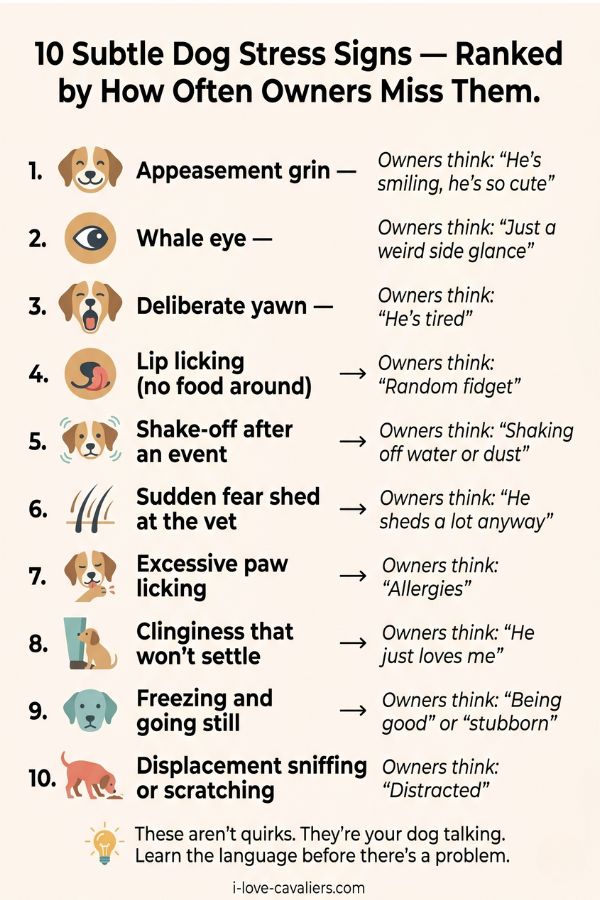
| Rank | Sign |
|---|---|
| 1 | Appeasement grin |
| 2 | Whale eye |
| 3 | Deliberate yawn |
| 4 | Lip licking with no food around |
| 5 | Shake-off after an event |
| 6 | Sudden fear shed at the vet |
| 7 | Excessive paw licking |
| 8 | Clinginess that won’t settle |
| 9 | Freezing and going still |
| 10 | Displacement sniffing or scratching |
If your dog is doing any of the top three regularly, start there. Those are the signs the rest of the dog world misses by the widest margin.
1. The Appeasement Grin
This is the one that got me. Lips pulled back, teeth visible, ears flattened, eyes squinted and soft. It looks like a guilty smile from a sitcom.
It’s actually a stress signal documented by behaviorists for decades. The dog is saying, “I’m no threat, please ease up.” Owners almost universally read it as happiness or guilt.
If your dog does this when kids hug them, when you scold them, or when a stranger leans over them, that’s not joy and it’s not guilt. That’s a polite request for space.
2. Whale Eye (The Half-Moon of White)
Whale eye is when the dog turns their head one way but keeps their eyes locked on something, showing a crescent of white sclera. It’s one of the strongest predictors of a bite in the canine behavior literature. Stronger than a growl.
Snickers does it when a delivery driver lingers at the door too long. He turns his head away to look calm. His eyes stay fixed. The whites show.
If you see whale eye, interrupt the situation immediately. Move the dog, move the trigger, change the room. Don’t wait to see what happens next.
3. The Deliberate Yawn
Not every yawn is a stress yawn. Sleepy yawns are loose, wide, full-bodied. The dog’s whole face relaxes.
Stress yawns are different. They’re tight, deliberate, often pointed in the direction of the trigger. The dog’s body stays stiff. The yawn looks more like a stretch than a sleep cue.
Norwegian trainer Turid Rugaas documented yawning as a “calming signal” dogs actively use to defuse tension. Read context. A yawn during a thunderstorm or at the groomer’s table is almost never about sleep.
4. Lip Licking When There’s No Food
A quick flick of the tongue across the nose with no food, treat, or peanut butter anywhere in sight. This is what behaviorists call a displacement signal. The dog is mildly stressed and self-soothing.
You’ll see it during awkward handling, during scolding, or when a stranger approaches too fast. Most owners genuinely don’t notice it. It’s that fast.
Once you start watching for it, you’ll see it ten times a day. That’s not a problem, it’s information.
5. The Shake-Off After Something Stressful
You know how dogs shake their whole body to dry off after a bath? Sometimes they do the exact same shake when they’re bone dry.
That’s called a shake-off, and it’s a decompression move. The dog just got through something tense (a vet exam, a long cuddle from a toddler, a near-miss with a bigger dog) and they’re literally shaking the stress out of their nervous system.
Watch for it. If your dog does a full-body shake right after every visit to your in-laws, that’s not random. That’s a review.
6. Sudden Shedding at the Vet (Fear Shed)
Walk into a vet’s office and look at the floor near the exam tables. There’s always hair. Lots of hair.
Acute stress spikes cortisol within minutes. The cortisol surge weakens the bond between hair and follicle in the resting phase. Hair sheds in clumps. Vet techs call this “fear shed”, and it’s so consistent that researchers now use hair cortisol levels as a welfare measurement tool.
If Snickers gets out of the car at the vet and suddenly looks like a coat about to fall apart, I know exactly what’s happening. He’s not getting old. He’s terrified.
7. Excessive Paw Licking
This one’s tricky because there are real medical reasons for paw licking too. Allergies are common in dogs and they absolutely cause itchy paws.
But chronic paw licking with no allergy diagnosis is often a self-soothing stress behavior. The rhythm is calming. Same idea as a person biting their nails.
Pro tip: Look for the pattern. Allergy licking happens randomly and seasonally. Stress licking happens at specific times. When you leave for work. When the doorbell rings. When the house gets loud. If the licking has a trigger, it’s a stress sign (and yes, I’ve made this exact mistake with Snickers).
8. Clinginess That Won’t Settle
Some dogs are naturally clingy. They follow you to the kitchen, they sleep on your feet, they want to be in the same room as you. That’s normal companionship.
The stress version is different. One word makes the difference. Settling.
A relaxed clingy dog follows you to the kitchen, lies down at your feet, naps. An anxious dog follows you to the kitchen and can’t stop moving. Pacing. Whining. Eyes locked on you. They never actually rest. If your dog can’t decompress even when you’re sitting still next to them, that’s not love, that’s distress.
Not gonna lie, this one took me the longest to accept.
9. Freezing and Going Still
A frozen dog is a dog in trouble. They look obedient. They look “good.” They’re not.
Freezing is the second-to-last step in the bite ladder. The dog has run out of polite signals and is locked up in fight-or-flight. People praise frozen dogs all the time, especially in vet offices and around children. It’s the most misread sign on this list.
If your dog goes statue-still during something, especially while being touched or approached, stop what’s happening. Don’t ask them to push through it. Let them move away.
10. Displacement Behaviors (The Weird Mid-Interaction Stuff)
Out of nowhere your dog stops, sniffs the carpet intensely, scratches behind one ear, or starts grooming a paw. Mid-conversation, mid-cuddle, mid-anything.
That’s displacement. The dog is uncomfortable and performing a random behavior to manage the stress. It looks like distraction. It’s actually self-regulation.
Once you see it, you can’t unsee it. Snickers does the carpet-sniff at the vet’s office every time. Same patch of carpet. Every visit. Pretending he found something fascinating instead of admitting he wants to leave.
What NOT to Do When You See These Signs
Reading the signs is half the job. How you respond is the other half. A few things to stop doing immediately.
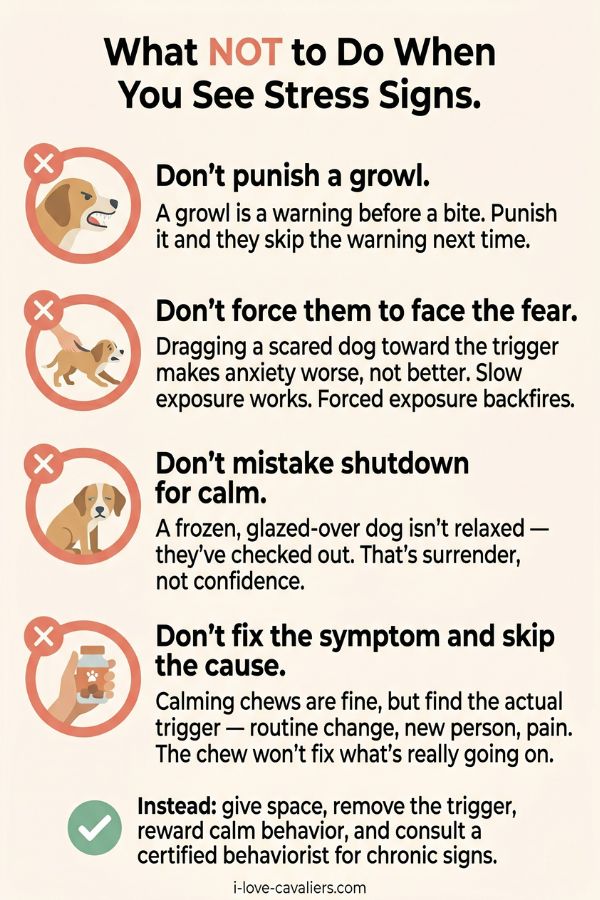
- Don’t punish a growl. A growl is the gift right before a bite. If you punish it, your dog learns that warnings get them in trouble. So they skip the warning next time. You’ve now created a dog who bites without notice. Every certified behaviorist I’ve read has said the same thing.
- Don’t force them to face the fear. Dragging a scared dog toward the thing that scares them (“just let him smell it, he’ll see it’s fine”) is called flooding. Flooding makes anxiety worse, not better. Slow exposure works. Forced exposure backfires.
- Don’t mistake shutdown for calm. A frozen, glazed-over dog who isn’t fighting back isn’t relaxed. They’ve checked out. If your dog suddenly “behaves” in a scary situation, ask whether that’s confidence or surrender.
- Don’t fix the symptom and skip the cause. Anti-anxiety chews are fine. Calming sprays are fine. But if your dog is showing chronic stress signs, find the trigger. Routine change? New person? Pain? The chew won’t fix what’s actually going on.
The first one is the most important. Everything else flows from it.
When It’s Actually Pain, Not Stress
Here’s the part most online articles skip and it’s the part that genuinely matters.
A lot of what looks like anxiety is actually physical pain. Arthritis. Dental disease. Ear infections. GI discomfort. Skin conditions. Dogs can’t tell you their hip hurts, so they tell you with their behavior. And behavioral stress is almost identical to pain behavior from the outside.
Pain signs that get mislabeled as stress:
- Yelping when you pick them up a certain way
- Sensitivity to a collar or harness around the neck
- Sudden refusal to jump on the couch they’ve used for years
- Restlessness at night, especially after lying down
- New “clinginess” in a dog that used to settle fine alone
- Sudden grumpiness toward kids or other pets
If your dog is showing more stress signs than they used to, a vet check comes before a behaviorist visit. Always. Veterinary behaviorists consistently flag this. What gets labeled a behavior problem is often a pain problem, an anxiety problem, or both. Training cannot fix pain.
The older the dog, the more likely pain is the real driver. New stress behaviors in a senior dog should be treated as a medical symptom until your vet rules it out.
What I Watch For Now When Snickers Walks Into a Room
I look at his face before I look at his tail.
That’s the biggest thing I changed after the appeasement grin photo. The tail wags lie all the time. The face tells the truth.
He’s curled up next to me right now, full pancake on the couch, paws twitching through whatever rabbit he’s chasing in his dream. No tongue flick, no shake-off, no whale eye. Just a soft sleeping dog who feels safe enough to disappear into a nap.
That look used to feel ordinary. Now I notice it every single time. It’s the look I’m chasing for the rest of his life.
I’m a passionate dog lover and home cook, but I’m not a certified veterinarian or animal behaviorist. If your dog is showing chronic stress signs, especially new ones or signs combined with physical symptoms, talk to your vet first to rule out pain or medical causes.
Give your pup an extra scratch from me.