Snickers wouldn’t stop pacing by the mudroom door. My friend Marko had just walked in with a Ziploc bag of ground venison from his October harvest, and my Cavalier had clocked it before the door even closed. He sat by my feet with the exact posture he uses when he wants something. Ears back, tail sweeping the floor, eyes locked on the counter.
I’d been meaning to switch Snickers off his kibble for a few weeks. He’d been scratching more than usual, and our vet had floated the idea of trying a novel protein for a couple of months to rule out a food sensitivity. Venison wasn’t something I’d planned for. But there was a whole bag of it thawing on my counter, and turning it into dog food felt like the obvious next move.
I almost got it wrong. My first version was pure venison, sweet potato, and green beans. Looked great. Two weeks in, Snickers’s coat looked drier than before I started. Turns out venison is one of the leanest proteins you can feed a dog, and I hadn’t accounted for that at all.
This is the recipe I landed on after fixing that mistake (and a couple of others). It’s balanced, freezer-friendly, and gentle enough for dogs with sensitive stomachs.
Why Venison Works So Well for Sensitive Dogs
Ground venison is what vets call a novel protein. Most commercial dog foods are built around chicken, beef, lamb, or fish, which means most dogs have been eating those proteins their entire lives. If your dog has developed an allergy, chances are the culprit is one of those four.
Venison flips that. Only around 5 to 10 percent of dogs have ever had it in their bowl, so the immune system usually hasn’t had a chance to react to it. That’s why it shows up so often in prescription elimination diets.
If your vet has asked you to try a novel protein for 8 to 12 weeks to rule out a food sensitivity, venison is one of the strongest options you can pick.
Beyond the allergy angle, ground venison brings some real nutritional wins:
- High-quality protein. Around 22% by weight, with a complete amino acid profile.
- Iron and B12. Both in the heme form your dog absorbs efficiently.
- Zinc. Supports coat health and immune function.
- Lower cholesterol than beef. With more omega-3 than most other red meats.
That last one gets talked up a lot, but there’s a catch. The omega-3 in venison is mostly ALA, the plant form. Dogs convert it to the more useful EPA and DHA at only around 5 to 15 percent efficiency. That’s why I still add fish oil to Snickers’s bowl even though venison is technically an omega-3 source.
If you’re already batch-cooking for your dog, our homemade dog food meal prep guide walks through the freezer workflow that makes any of these recipes actually sustainable.
Ground Venison Dog Food Recipe
This makes roughly 6 pounds of finished food, enough for a 40 lb dog for about 6 days at two meals a day.
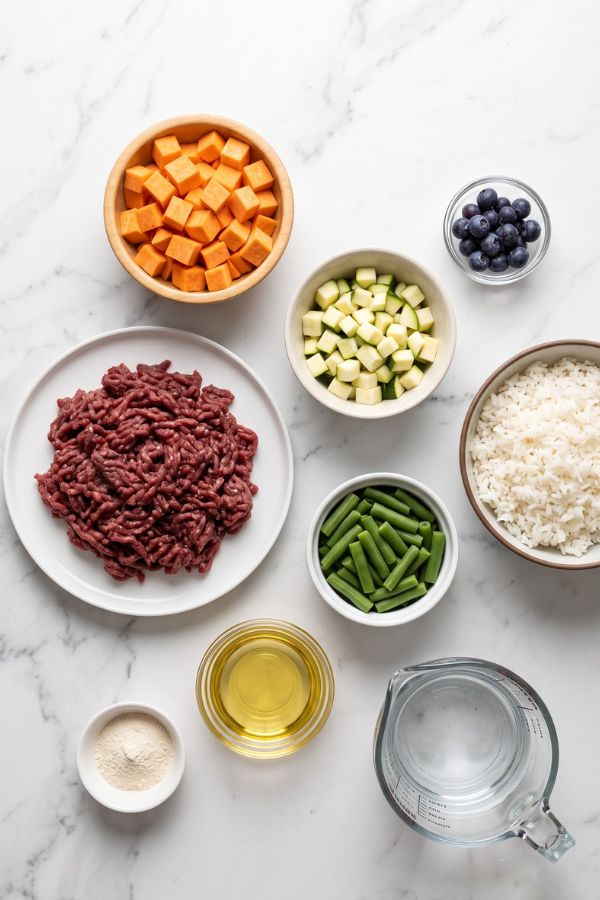
Ingredients
| Ingredient | Amount | Why it’s in there |
|---|---|---|
| Ground venison | 3 lbs | Primary protein |
| Sweet potato, diced | 2 cups | Slow carbs, beta-carotene, fiber |
| Zucchini, diced | 1 cup | Low-cal filler, moisture |
| Green beans, chopped | 1 cup | Fiber, magnesium |
| Blueberries | 1/2 cup | Antioxidants |
| Cooked white rice | 1 1/2 cups | Gentle carb, calorie base |
| Sunflower oil | 3 tbsp | Fat gap fix |
| Ground eggshell powder | 3 tsp (about 1 tsp per pound of meat) | Calcium |
| Water | 1 cup | For simmering |
Step 1: Prep the Vegetables
Wash and dice the sweet potato into 1/2-inch cubes. Chop the zucchini and green beans into pieces roughly the size of your dog’s kibble. Keep the blueberries whole. You want everything about the same size so it distributes evenly in the final mix.
Step 2: Brown the Venison
Warm a large stockpot over medium heat. Add the ground venison and break it up with a wooden spoon as it cooks. You don’t need to add oil to the pan; venison releases enough moisture on its own. Cook for 8 to 10 minutes, until the meat hits 160°F internal temperature. This is non-negotiable, especially with wild game (don’t skip your thermometer here).
Step 3: Simmer the Vegetables In
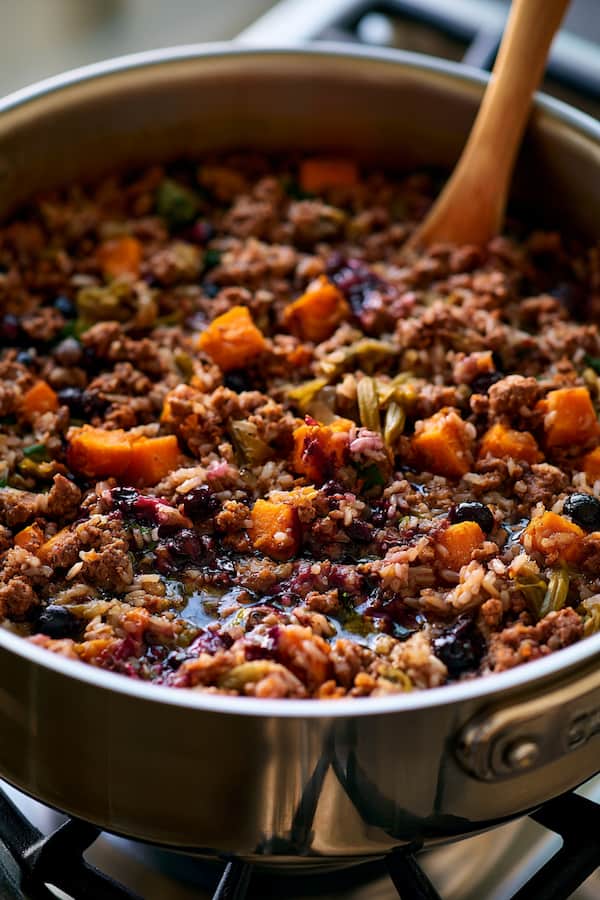
Add the diced sweet potato, zucchini, green beans, and 1 cup of water to the pot with the browned venison. Cover and reduce heat to medium-low. Simmer for 12 to 15 minutes, until the sweet potato is fork-tender.
Step 4: Add the Rice and Blueberries
Stir in the cooked white rice and blueberries. Turn off the heat and let the pot sit covered for another 3 minutes. The residual heat softens the blueberries just enough without turning them into mush.
Step 5: Cool and Finish
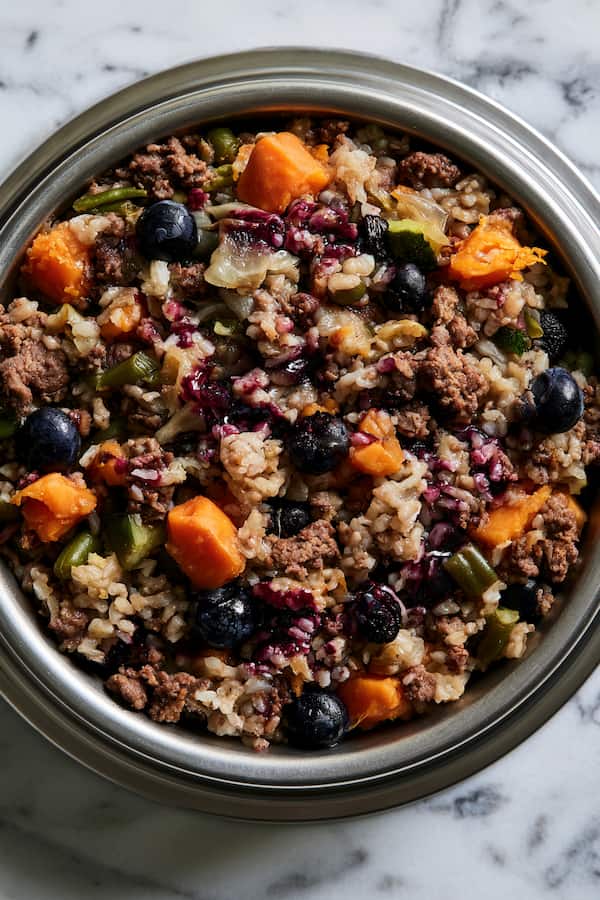
Uncover the pot and let the food cool to room temperature. This usually takes about 30 minutes. Once it’s cool enough to touch, stir in the sunflower oil and ground eggshell powder. Mix thoroughly so the calcium distributes evenly (this part matters more than it sounds).
You’ll end up with roughly 6 pounds of finished food.
Getting the Calcium Right
This is where most homemade dog food recipes quietly fail. Muscle meat and vegetables alone give you a calcium-to-phosphorus ratio somewhere around 1:10. Your dog needs it closer to 1:1 or 2:1. That’s a bigger gap than most owners realize.
Long-term feeding of an unbalanced diet has been documented to cause skeletal issues in dogs. A published case report described a 6-month-old giant schnauzer that developed compression fractures on a homemade diet with an inverted Ca:P ratio. This is not a hypothetical risk.
The fix takes about 30 seconds. Add 1 teaspoon of ground eggshell powder per pound of boneless meat. One egg’s worth of dried, ground shell contains around 2,000 mg of calcium, which is enough to correct the ratio for a small batch.
To make your own eggshell powder:
- Rinse and dry the shells from 10 to 12 eggs
- Bake at 300°F for 10 minutes to sterilize
- Grind in a clean coffee grinder or blender until fine as flour
- Store in a sealed jar for up to 2 months
One important note. Eggshell powder is calcium-only, so it’s not adequate for growing puppies or nursing mothers. Those dogs need bone meal, which delivers both calcium and phosphorus. Ask your vet before feeding this recipe to a puppy under 12 weeks.
For more on the balance side of homemade cooking, our holistic homemade dog food recipe covers the full nutrient picture in more depth.
Portion Size by Dog Weight
The rough rule is 2 to 3 percent of your dog’s body weight per day, split into two meals. Here’s what that looks like in grams so you can actually measure:
| Dog weight | Daily amount | Per meal (2x/day) |
|---|---|---|
| 10 lbs | 100-140 g | 50-70 g |
| 20 lbs | 200-280 g | 100-140 g |
| 30 lbs | 300-420 g | 150-210 g |
| 40 lbs | 400-560 g | 200-280 g |
| 60 lbs | 600-840 g | 300-420 g |
| 80 lbs | 800-1000 g | 400-500 g |
Active or working dogs can go toward the higher end. Seniors and couch potatoes stay closer to the lower end. The most reliable way to calibrate is your dog’s body condition, not the math. If you can feel their ribs with light pressure but not see them, you’re in the right zone. If they’re softening around the middle, cut back 10 percent for two weeks and check again.
A digital kitchen scale is the single best tool for this. Guessing by cups is how dogs slowly gain 5 pounds without anyone noticing.
Storage and Meal Prep
Here’s the freezer routine I use, and it’s genuinely saved me hours every week.
Portion the cooled food into daily servings using freezer-safe bags or silicone containers. Flatten each bag so it stores like a tile and thaws in half the time. Label with the date and freeze immediately if you’re prepping more than 4 days ahead.
- Fridge: Good for 4 days in a sealed container. Any longer and the vegetables start to weep.
- Freezer: Up to 3 months. Beyond that the fat begins to oxidize and the food loses appeal.
- Thawing: Move the next day’s portion from freezer to fridge the night before. Never microwave frozen dog food; hot spots form and the texture gets weird.
If you batch-cook for the freezer, our cheaper than kibble breakdown shows how the per-day cost actually compares once you’re prepping in bulk.
What to Know if You’re Using Wild-Harvested Venison
This section is for anyone getting venison from a hunter friend or their own harvest. Farmed venison from a butcher skips most of this.
Cook It to 160°F
Ground game meat should always hit 160°F internal temperature per USDA guidance. That kills Toxoplasma, tapeworms, and any bacterial contamination from processing. Don’t feed wild venison raw to your dog. The risk isn’t worth the marginal nutrient benefit.
The CWD Question
Chronic Wasting Disease is a prion disease in the deer family. There are no documented cases of dogs contracting CWD, and dogs aren’t considered a susceptible species. That’s the good news.
The nuanced version is this. State wildlife agencies (Wisconsin, Minnesota, Maryland) still recommend against feeding high-risk tissues like brain, spinal cord, eyes, spleen, or lymph nodes to pets from CWD-endemic areas. Ground venison from a properly butchered animal typically excludes these tissues, so the risk stays very low. If you’re processing your own deer, keep those tissues out of the grind.
CWD is now present in 29 states and 391 counties as of 2024. If you hunt in one of those zones, testing your deer before consuming (or feeding) is standard practice.
Freeze Before Feeding, Even If You’re Cooking
I freeze wild venison for at least 3 weeks before using it, even though I’m cooking it. The freeze knocks down parasite loads (specifically Toxoplasma) as an extra layer of safety. It’s a small habit that costs nothing.
Snickers Approved the Second Batch
The first version was the pure venison one, the one I got wrong. The second batch, with the oil and eggshell powder mixed in, was the one that made a difference. Snickers’s coat got its softness back within about ten days, and his morning energy came back with it.
He still checks the mudroom every October when the weather turns. I don’t know if he remembers Marko showing up with that first bag or if he just knows the smell of fresh venison drifting in on cold air. Either way, the pacing by the door hasn’t stopped.
If your dog is dealing with itchy skin or a sensitive stomach and your vet has floated a novel protein trial, this recipe is a solid place to start. Get the fat right, get the calcium right, and the rest is just cooking.
I’m a passionate dog lover and kitchen enthusiast, but I’m not a certified veterinarian or animal nutritionist. Long-term homemade diets should always be discussed with your vet to make sure your pup is getting everything they need.
Bon appétit to your furry friend!