It was the middle of June and Snickers wouldn’t stop scratching behind his ear. I parted the fur and saw one of those little black dots run for cover. One single flea. Just one.
Which meant probably fifty more I couldn’t see, and probably another two thousand eggs in my house I really couldn’t see.
I’d been dragging my feet on the chemical spot-on for months. A friend’s dog had a rough reaction to one and I just didn’t want to go there. So I went down the DIY rabbit hole.
Bought apple cider vinegar. Bought witch hazel. Bought essential oils that, it turned out, could have actually hurt him.
This is the article I wish I’d read before mixing anything. I’ll give you two recipes that genuinely repel fleas, I’ll tell you the ones that are dangerous, and I’ll explain why even the best DIY spray will fail if you’re not also treating the environment.
Let’s do it properly.
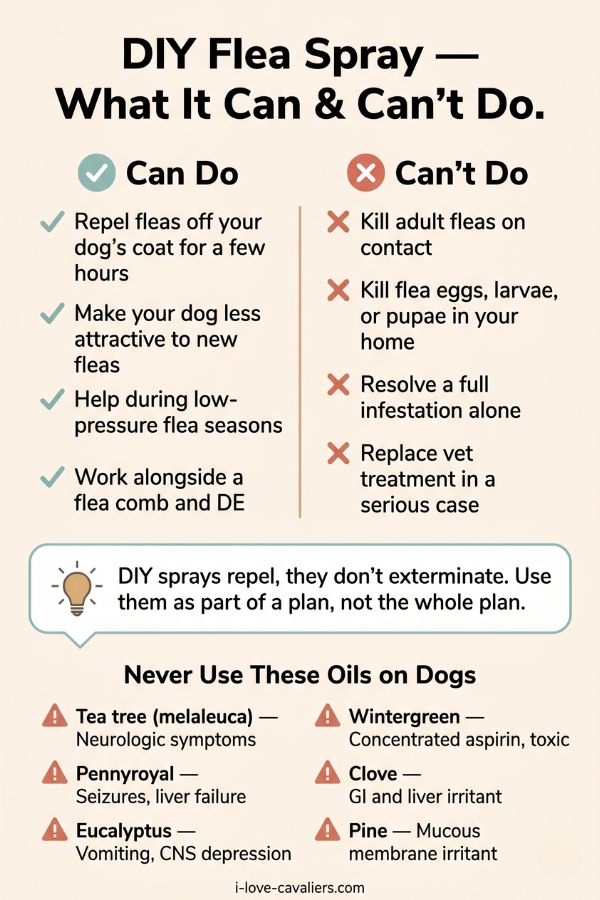
What DIY Flea Spray Can and Can’t Do
| Can | Can’t |
|---|---|
| Repel fleas off your dog’s coat for a few hours | Kill adult fleas on contact |
| Make your dog less attractive to new fleas | Kill flea eggs, larvae, or pupae in your home |
| Help during low-pressure flea seasons | Resolve a full infestation alone |
| Work alongside a flea comb and DE | Replace vet-recommended treatment in a serious case |
The honest truth: DIY sprays repel, they don’t exterminate. Use them as part of a plan, not the whole plan.
The Honest Truth Before You Mix Anything
Most DIY flea spray articles promise the world. The real picture is more nuanced.
Apple cider vinegar doesn’t kill fleas. It alters the pH of your dog’s coat slightly, which fleas find less appealing, so they hop off. They don’t die. They go somewhere else. Often back into your carpet.
Essential oils repel through scent. Cedarwood and lavender work because fleas hate the smell, not because they’re insecticidal at home-use concentrations.
This matters because if you spray your dog and the fleas seem to disappear for a day, you might think the problem is solved. It’s not.
The eggs and larvae in your environment are still hatching. The spray buys you a window, not a fix. Plan around that.
Essential Oils That Are Toxic to Dogs (Don’t Use These)
A lot of “natural” recipes online include oils that are flat-out dangerous. Skip every recipe that contains any of these.
- Tea tree (melaleuca) oil. Causes muscle weakness, ataxia, and depression even in small topical amounts. The ASPCA documented neurologic symptoms in 100% of dogs exposed to undiluted tea tree oil in one study.
- Pennyroyal oil. Can cause seizures and liver failure. One of the most dangerous essential oils for dogs.
- Eucalyptus oil. Toxic to dogs, causes drooling, vomiting, and CNS depression.
- Wintergreen oil. Contains methyl salicylate, basically concentrated aspirin. Toxic.
- Clove oil. Strong gastrointestinal and liver irritant.
- Pine oil. Mucous membrane irritant, not recommended.
Concentrated lemon and peppermint oils are also a bigger risk than most articles admit. Diluted steeped lemon water is gentler. Concentrated peppermint essential oil is something I’d skip entirely on puppies, pregnant dogs, and nursing dogs.
Cedarwood and lavender are the two oils most professionals consider relatively safer for dogs, and even those should be diluted to under 1% concentration. That’s roughly 6 drops per ounce of carrier liquid. Less is more.
Recipe 1: The Apple Cider Vinegar Spray (Mild Repellent)
This is your gentle, daily, low-risk option. Good for sensitive dogs, puppies over 12 weeks, and dogs with skin issues that wouldn’t tolerate essential oils.
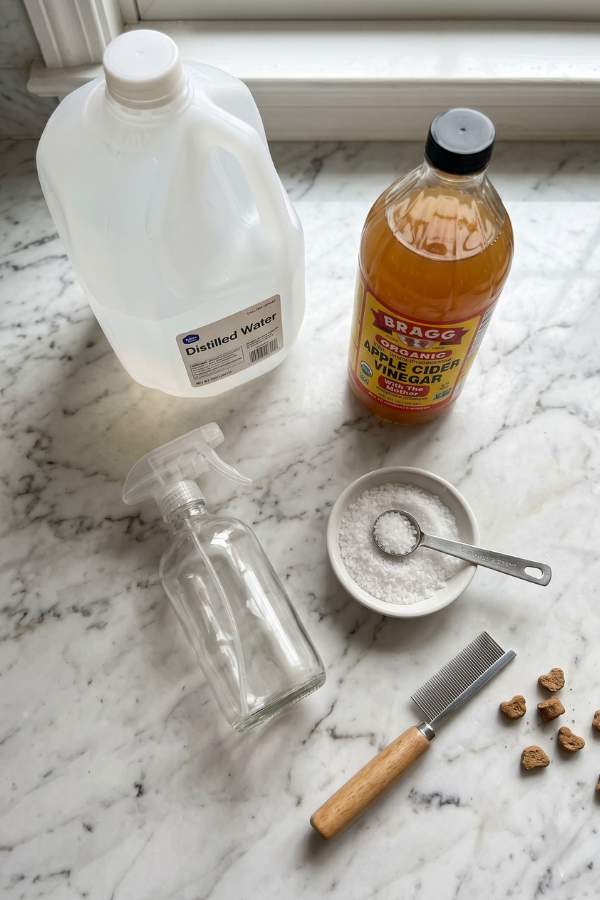
Ingredients
| Ingredient | Amount | Notes |
|---|---|---|
| Raw apple cider vinegar (with the mother) | 1 cup | Bragg’s is the easy default |
| Distilled or filtered water | 1 cup | Tap is fine in a pinch |
| Sea salt | 1 teaspoon | Optional. Adds a tiny abrasive boost |
Steps
- Pour the ACV and water into a clean glass spray bottle.
- Add the salt if you’re using it. Shake until dissolved.
- Mist lightly over your dog’s coat, avoiding the face, eyes, ears, and any open scratches.
- Run a flea comb through after misting. The fleas that jump off get caught.
- Reapply every 2-3 days during peak flea season, or every 7 days as maintenance.
Shake before every use. The mix separates.
Shelf life is about 2 weeks if kept somewhere cool and dark. ACV is shelf-stable on its own, but once diluted with water it can grow film. Make small batches.
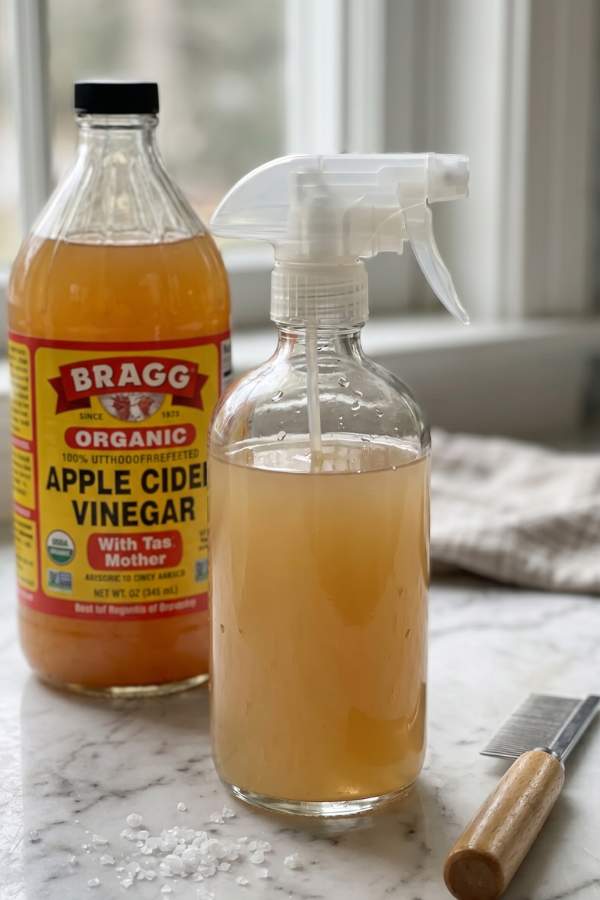
I’ll be honest, the smell is a lot. Snickers gives me a look like he’s been personally insulted every time. The smell fades in about an hour and he forgives me by dinner.
Recipe 2: The Cedar + Lavender Witch Hazel Spray (Stronger Repellent)
This is the one I reach for when flea pressure is heavier. Use only on healthy adult dogs over 12 weeks old. Don’t use this on pregnant, nursing, or sick dogs. Don’t use it anywhere a cat might lick.
Ingredients
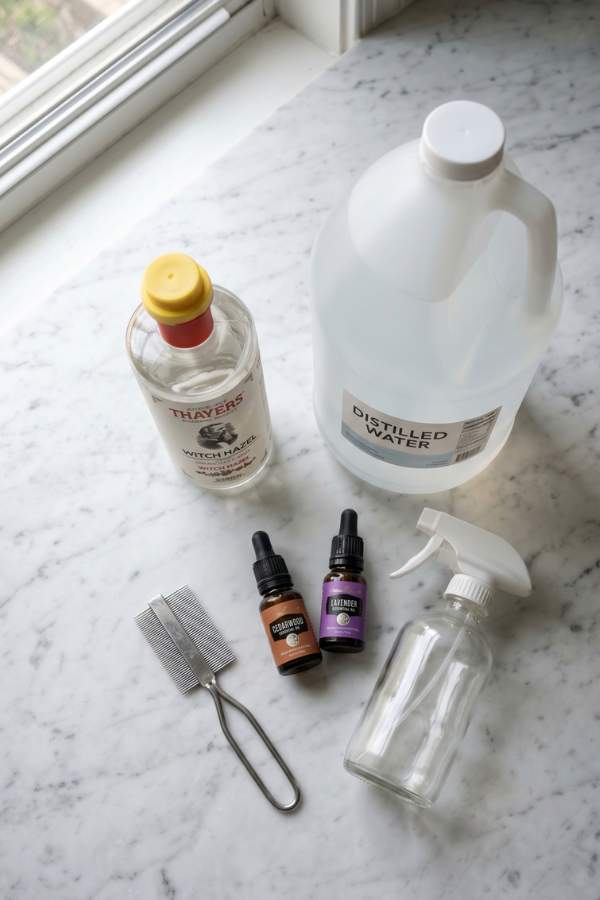
| Ingredient | Amount | Notes |
|---|---|---|
| Witch hazel | 1 cup | Choose alcohol-free if you can |
| Distilled water | 1/2 cup | |
| Cedarwood essential oil | 6 drops | Therapeutic-grade only |
| Lavender essential oil | 4 drops | Same |
| Glass spray bottle | 1 | Essential oils degrade plastic |
Steps
- Pour the witch hazel and water into the spray bottle.
- Add the cedarwood and lavender drops.
- Cap tightly and shake hard for 30 seconds.
- Patch-test on a small section of your dog’s belly. Wait 24 hours. If you see any redness, dump it and switch to Recipe 1.
- Once patch-tested clean, mist the coat lightly, focusing on the back, belly, and around the base of the tail. Avoid the head entirely.
- Comb through with a flea comb afterward.
- Reapply every 3-4 days.
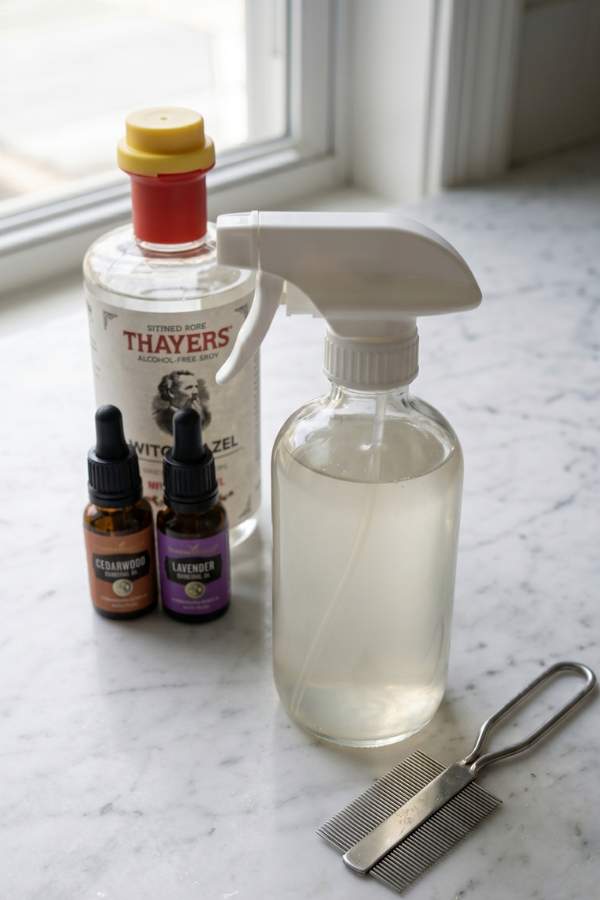
Never use this spray on cats, even by accident. Cats can’t metabolize many essential oils and even small exposure can be serious.
How to Apply Without a Wrestling Match
The biggest reason DIY sprays fail isn’t the recipe. It’s that the dog hates being misted and the owner stops doing it after three tries.
Two tricks that actually work:
- Spray onto a cloth first, then wipe. Most dogs panic at the hiss of a spray bottle. Misting a microfiber cloth and wiping along the coat removes that whole problem. Bonus: it actually gets the spray onto skin, not just sitting on top of fur.
- Pair every spray session with food. Lick mat with peanut butter, freeze-dried liver, anything good. The dog stops associating the bottle with stress. This took me about a week with Snickers and now he stands still on his own.
Spray after a walk, not before. The coat is warm, the pores are slightly open, and the scent settles in better. Reapply after baths or after rain because the oils wash right off.
The 95% Problem: Why Spraying Your Dog Alone Will Never Win
Here’s what almost no article tells you. Adult fleas are only about 5% of the total flea population in an infested home. The other 95% are eggs, larvae, and pupae living in your carpet, your dog’s bedding, the cracks between floorboards, and the soft furniture.
A single female flea lays up to 2,000 eggs in her lifetime, and those eggs roll off your dog and into the environment within hours. Pupae stay inside sticky cocoons that are nearly impossible to kill with anything, chemical or natural. They can hatch weeks or months later.
So if you spray your dog and only your dog, here’s what happens. You repel a few adults. They jump off into your house. The eggs hatch. The larvae mature. Within two weeks, you’re back where you started, and you think the spray “stopped working.” The spray didn’t stop working. It was never going to win alone.
The dog is 5% of the problem. Your house is 95% of it.
Treat the Environment, Not Just the Dog
This is the part that actually wins.
Vacuum Like You Mean It
Vacuum every soft surface in the house every other day for the first three weeks. Carpets, rugs, furniture, dog bed, baseboards, all of it. Empty the canister or bag outside immediately so the eggs don’t hatch in your vacuum. This single habit kills more fleas than any spray.
Wash All Bedding in Hot Water
Your dog’s bed, your bed if he sleeps on it, any blankets he uses. Hot water (60°C+ / 140°F+) kills eggs and larvae. Weekly during an outbreak.
Sprinkle Food-Grade Diatomaceous Earth on Carpets and Bedding
This is the closest thing to a natural flea killer that actually works. Food-grade DE (never pool-grade) has microscopic jagged edges that destroy the flea’s exoskeleton and dehydrate it. It kills adults and some larvae mechanically. Eggs and pupae survive, so you’ll need repeated applications.
Sprinkle a thin layer on carpets and dog bedding. Work it in gently with a soft brush. Leave it for 24-48 hours. Vacuum thoroughly.
Wear a mask while applying. DE dust is bad for lungs (yours and the dog’s). Keep your dog out of the room while you work the powder in.
Use a Flea Comb Daily
A metal flea comb is the only tool that physically removes adult fleas and some eggs from the coat. Run it through your dog’s fur every day during an active issue. Dunk the comb in a bowl of soapy water between passes to drown what you catch. This is unglamorous, repetitive, and the single most effective thing you can do.
If your dog is itching even after you’ve gotten the fleas under control, it might not be the fleas at all. Persistent itching can be linked to food and environmental triggers, so look at natural remedies for dog allergies once the infestation is gone.
When to Stop DIY and Call the Vet
DIY has limits. There’s no shame in switching to a vet-recommended treatment when:
- Your dog is a puppy under 12 weeks. Their liver can’t process essential oils safely. Use a flea comb only, ask the vet for a puppy-safe option.
- You’re seeing flea dirt all over the bedding after two weeks of DIY effort. That’s an infestation that needs chemical environmental treatment.
- Your dog has hot spots, sores, or bald patches from scratching. That’s a skin issue now, not just a flea issue.
- You’ve got multiple pets, especially cats. Cats are extremely sensitive to essential oils. The whole household needs a coordinated plan.
A good vet will not shame you for trying DIY first. They’ll just help you stop the cycle.
Back to the Backyard
These days, Snickers and I have a summer routine. ACV spray on Sunday nights, flea comb every evening while I’m on the couch, DE on the dog bed every two weeks, and the vacuum runs Tuesday and Friday. He hasn’t had a flea in 18 months.
The pitch most articles sell is that DIY flea spray is a one-and-done magic potion. It’s not. It’s one piece of a system that works when you commit to all of it. The good news is the system isn’t expensive and it isn’t complicated. It’s mostly just consistent.
I’m a passionate dog parent, not a veterinarian or certified parasitologist. The recipes here are widely used and considered safer than many alternatives, but every dog is different. If your dog has chronic skin conditions, is pregnant or nursing, or you’re dealing with a serious infestation, talk to your vet before starting any DIY treatment.
Happy de-fleaing!