There’s an older gentleman I keep bumping into at the vet’s office. Big grey moustache, quiet voice, and a Labrador named Duke who’s always leaning against his knee like he’s trying to hold his owner up instead of the other way around.
Last month I overheard the receptionist ask how Duke was doing on his new insulin. The man just shook his head slowly. “He won’t touch the prescription food,” he said. “Not a bite.”
I looked down at Snickers, my Cavalier, sitting on my foot with his sunset-colored ears folded forward. He had no idea what diabetes was. He just wanted to go home. But the man’s words stayed with me the rest of the day.
That’s the reality with a diabetic dog. The vet writes down a diagnosis, hands you a bag of expensive kibble, and sends you on your way. Sometimes your dog takes one sniff and walks off. Then what?
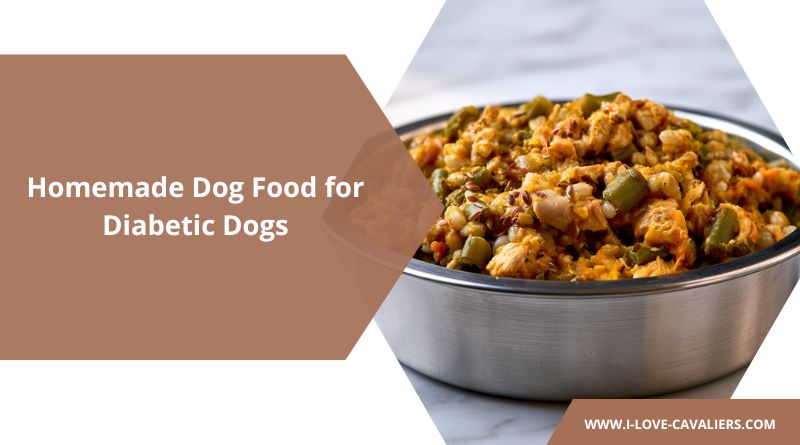
Turns out, you can absolutely cook for a diabetic dog at home. You just have to know which ingredients help their blood sugar and which ones send it through the roof. This recipe is the one I’d make if I were in that man’s shoes. Five real ingredients, portions that fit your dog’s weight, and the same feeding rules your vet would tell you about anyway.
Why Home-Cooked Meals Can Help a Diabetic Dog
A diabetic dog needs stable blood sugar between meals. That’s the whole game. When you cook at home you control every ingredient, which means:
- No hidden sugars. A lot of commercial treats and semi-moist foods use corn syrup, molasses, or “caramel” for flavor. All three spike glucose fast.
- More fiber, on purpose. Fiber slows how quickly food turns into blood sugar, and homemade lets you build it in from the start.
- Lean protein you can trust. Skinless chicken breast has almost no fat, which matters because diabetic dogs are more prone to pancreatitis.
- True consistency. Same bowl, same weight, same ingredients every day. Your dog’s insulin dose is calibrated to this.
One thing up front: any dietary change for a diabetic dog needs your vet’s approval first. This is not a “surprise your dog with a new diet” situation.
What Every Diabetic Dog Actually Needs on the Plate
Before we get to the recipe, here’s the nutritional shape you’re aiming for. Ignore the buzzwords on kibble bags. These are the targets that actually hold up in vet nutrition research.
High fiber. Between 10 and 20 percent dry matter for overweight dogs, 5 to 15 percent for dogs at a healthy weight. Fiber blunts the after-meal glucose spike.
Lean, high-quality protein. Skinless chicken, turkey breast, or white fish. Nothing greasy.
Low fat. Skip marbled beef and skin-on chicken thighs, especially if your dog has any pancreatitis history.
Complex, low-glycemic carbs. Barley, oats, and legumes are your friends. White rice, potatoes, and corn are not.
Dog Food Recipe for Diabetic Dogs
I picked these ingredients because each one earns its spot. Nothing filler. Nothing that spikes blood sugar. And nothing your dog will refuse to eat.
- Prep time: 15 minutes
- Cook time: 40 minutes
- Yield: about 8 cups
- Best for: dogs with vet-confirmed diabetes, on a stable insulin dose, cleared by their vet for a home-cooked or mixed diet
- Star ingredient: green beans (fiber powerhouse, almost zero calories)
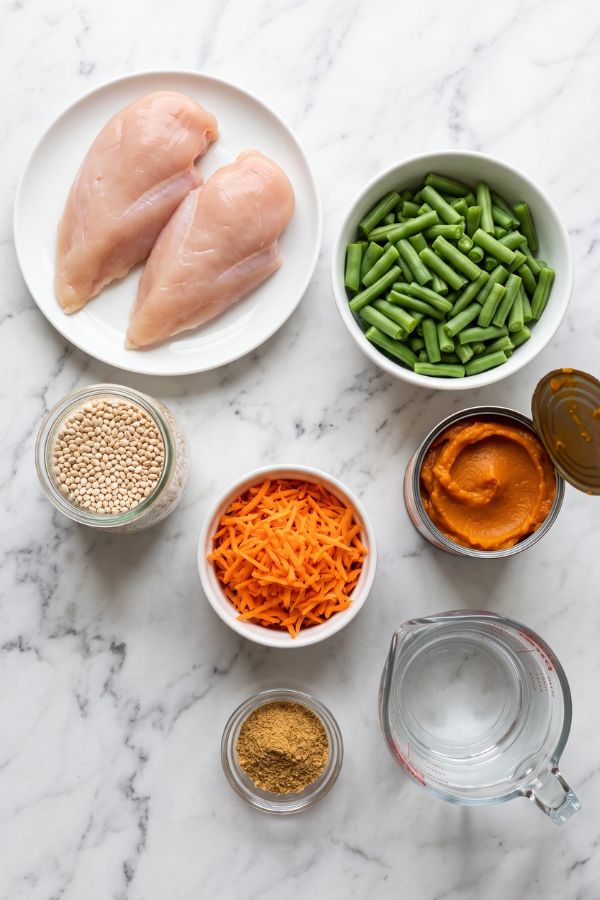
| Ingredient | Amount | Why It’s In Here |
|---|---|---|
| Skinless chicken breast | 1.5 lbs (about 680 g) | Lean protein, minimal fat |
| Pearl barley (dry) | 1 cup | Low-glycemic carb, adds soluble fiber |
| Fresh green beans, chopped | 3 cups | Insoluble fiber, low calorie, universally safe |
| Shredded carrots | 1 cup | Low-GI, natural sweetness dogs love |
| Canned pumpkin (100% pure, no sugar) | ½ cup | Soluble fiber, slows glucose absorption |
| Ground flaxseed | 1 tbsp | Omega-3, extra fiber |
| Water | 5 cups | For cooking |
A quick note on the pumpkin: it must be plain, 100 percent pumpkin. Pumpkin pie filling has added sugar and spices that would undo everything else in the bowl.
If your dog is on the smaller side, halve the batch. Do not add oil, salt, garlic, or onion. That stops being a recipe and starts being a vet bill.
Step 1: Rinse and Simmer the Barley
Rinse the pearl barley under cold water for about 20 seconds. Add it to a medium pot with 3 cups of water. Bring it to a boil, then drop to a low simmer and cover.
Let it cook for about 35 minutes, until tender but still with a bit of chew. Barley almost triples in volume, so don’t panic when the pot fills up.
Step 2: Poach the Chicken
While the barley cooks, put the chicken breasts in a separate pot and cover with cold water. Bring to a gentle boil, then reduce to a low simmer.
Poach for 15 to 18 minutes, until fully cooked with no pink in the middle. Poaching keeps the fat as low as possible (pan-frying adds oil you don’t want).
Once cool enough to handle, shred the chicken into bite-sized pieces with two forks.
Step 3: Steam the Vegetables
Steam the green beans and shredded carrots together for about 6 minutes. You want them tender but not mushy.
Never serve raw green beans as the main veg for a diabetic dog. Some dogs handle them fine, plenty of others get gas or loose stool, and any gastrointestinal upset messes with insulin timing.
Step 4: Combine and Cool
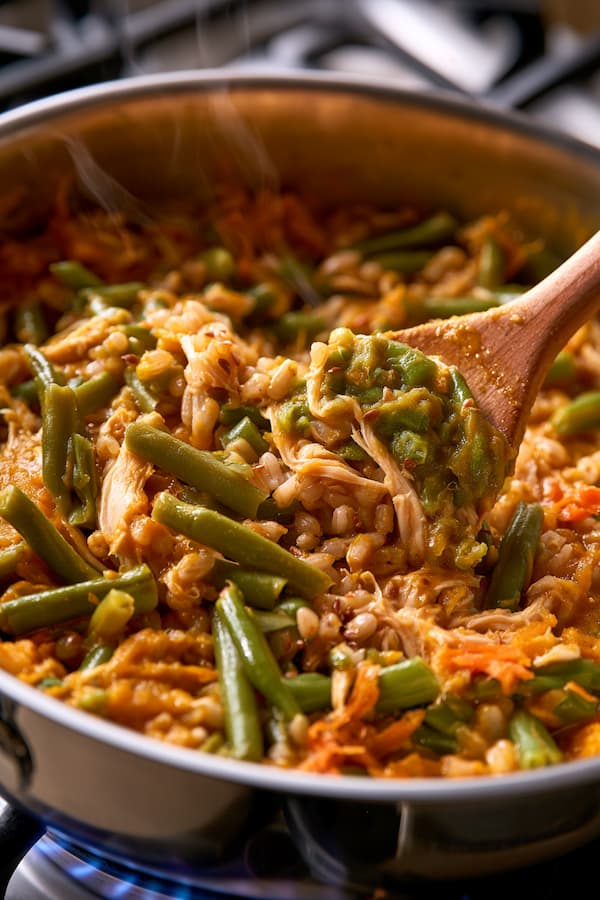
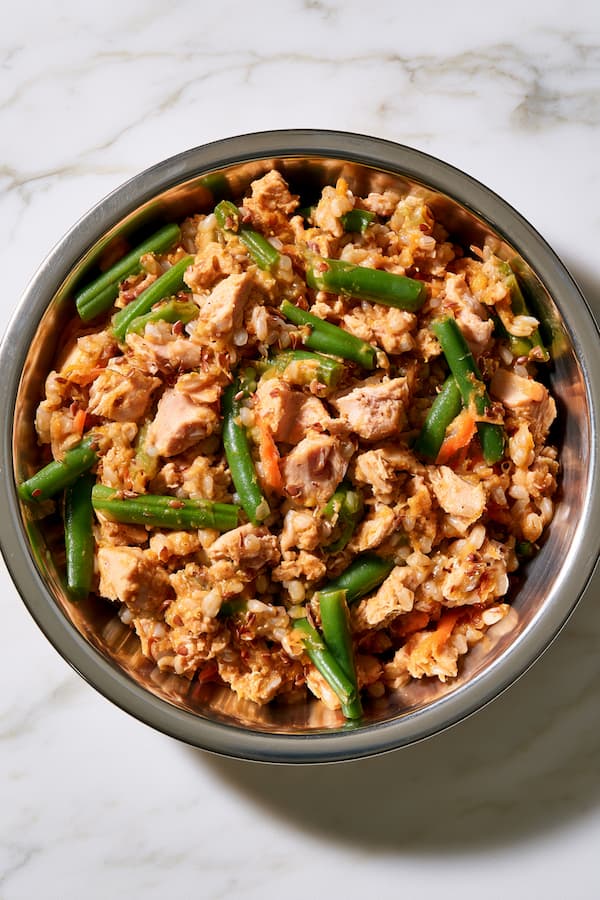
In a large bowl, add the cooked barley, shredded chicken, steamed vegetables, canned pumpkin, and ground flaxseed. Mix gently until everything is coated.
Let the mixture cool completely before serving or storing. Warm is fine. Hot is a burn risk.
Give the finished bowl one last look. You should see a mostly-green, chunky mix with visible chicken, vegetables, and barley. If it looks like porridge, drain a little liquid. If it looks dry, add a splash of the barley cooking water.
Storage and How Much to Feed
Fridge: keeps 4 days in a sealed container. Freezer: portion into daily servings and freeze for up to 2 months. Thaw overnight in the fridge, never on the counter.
Serving sizes for a diabetic dog need to be exact. Same amount, twice a day, no eyeballing. Weigh the food on a kitchen scale if you can.
| Dog Weight | Total Daily Amount | Per Meal (twice a day) |
|---|---|---|
| 10 lbs | ¾ cup | ⅜ cup |
| 20 lbs | 1¼ cups | ⅝ cup |
| 30 lbs | 1¾ cups | ⅞ cup |
| 50 lbs | 2¾ cups | 1⅜ cups |
| 70 lbs | 3½ cups | 1¾ cups |
These are starting points. Your vet may adjust based on your dog’s ideal weight, insulin dose, and glucose curve results. Always cross-check with your vet before switching your dog fully onto a homemade diet. Many vets prefer you start with a half-and-half mix. More on that in the FAQ.
Foods and Ingredients to Skip Completely
Some of these are obvious. A few will catch you off guard if nobody’s told you.
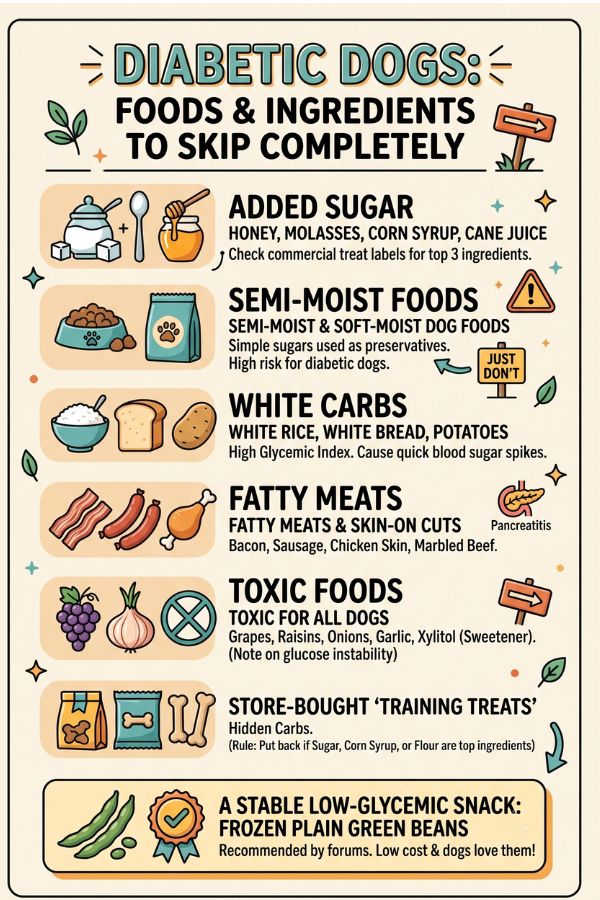
- Anything with added sugar. Honey, molasses, corn syrup, and “cane juice” all count. Flip commercial treat bags over and read the top three ingredients.
- Semi-moist and soft-moist dog foods. They use simple sugars as preservatives. This is a rare “just don’t” rule with no exceptions for diabetic dogs.
- White rice, white bread, and potatoes. High glycemic index, meaning they spike blood sugar quickly.
- Fatty meats and skin-on cuts. Bacon, sausage, chicken thighs with skin, marbled beef. The extra fat raises pancreatitis risk too.
- Grapes, raisins, onions, garlic, and xylitol. Toxic for any dog, but especially bad news when you’re already trying to keep glucose stable.
- Store-bought “training treats” with hidden carbs. If you see sugar, corn syrup, or flour in the top three ingredients, put it back.
Frozen plain green beans are the treat every diabetic dog forum swears by. They cost almost nothing and most dogs love them. This is the method I’d go with for a stable, low-glycemic snack (trust me on this one).
The Feeding Schedule That Keeps Blood Sugar Steady
Two meals a day, exactly 12 hours apart. That’s the rule.
Insulin gets given right after the meal, not before. Dose insulin before the meal and if your dog decides not to eat, you’ve got a hypoglycemia emergency on your hands. Feed first, confirm they’ve eaten most of the bowl, then dose.
If your dog eats less than about 75 percent of their meal, call your vet before giving a full insulin dose. Some vets have a “half dose” protocol for this. Others want you to skip and call. Know your vet’s rule before you’re standing in the kitchen at 7 a.m. trying to figure it out.
Free-feeding is off the table forever. Same food, same weight, same times, in the same order every day. Diabetic dogs thrive on boring routines. Boring is safe.
Back to That Waiting Room
I saw the man with the Labrador again a few weeks later. Duke was leaning against him same as always, but this time his owner was holding a Tupperware container that smelled faintly of chicken and barley. He caught my eye and gave a small, tired thumbs up.
Snickers, of course, tried to sniff the container. He got a firm no. He accepted it with dignity, then flopped onto my foot to wait for our appointment. Some dogs really do have all the luck.
I’m a passionate dog lover and kitchen enthusiast, but I’m not a certified veterinarian or animal nutritionist. Diabetic dogs need a diet plan built with your vet, and any change to food, portions, or feeding times should be run past them first. Long-term homemade diets are best formulated with a board-certified veterinary nutritionist to make sure your pup is getting every nutrient they need.
Wishing your dog steady numbers and boring, uneventful days.