The vet’s scale beeped, and Snickers sat on it like he’d won something. He hadn’t. The number was higher than I expected, and the vet gave me that polite look that says “we need to talk about treats.”
I was ready to defend myself. Snickers eats good food, I measure his kibble, and his treats are “healthy” ones from the pet store with a leaf on the bag.
Then she asked me how many of those he got a day. I started counting out loud and stopped somewhere around the second hand.
Turns out I wasn’t alone. According to the Association for Pet Obesity Prevention, 59% of dogs are overweight or obese, and a lot of owners look at their chubby dog and see “normal.”
That afternoon I went home, opened the fridge, and started looking at snacks the way the vet does. Calories first, nutrition second, marketing never.
This is the list I ended up with.
What Actually Makes a Dog Snack Healthy
“Healthy” on a treat bag can mean almost anything. When I started looking at snacks properly, four things mattered.
- Low calories per bite. A snack can be packed with vitamins and still push your dog over their daily budget if each piece is calorie-dense.
- A real whole food. Something you can recognize, like a green bean or a piece of chicken, not a shaped paste with 20 ingredients.
- An actual nutrient reason. Fiber, lean protein, omega-3s, water, antioxidants. If I can’t name why it’s good, it doesn’t make the list.
- Safe to prepare at home. No seeds, pits, cores, salt, butter, or seasoning, and cut to a size your dog can’t choke on.
The ranking below weighs all four. Veggies win on calories, proteins win on nutrition per bite, and the bottom of the list is still healthy, just easier to overdo.
How Many Snacks Your Dog Can Have Each Day
Vets use a simple rule. The AKC puts it this way: treats should make up no more than 10% of your dog’s daily diet, and that 10% means calories, not the number of treats.
So the real question is how many calories your dog needs in the first place.
The Ohio State veterinary nutrition team uses a starting formula: body weight in kilograms raised to the ¾ power, times 70. For a typical spayed or neutered adult, you multiply that by about 1.6.
I ran the numbers for common sizes so you don’t have to.
| Dog’s weight | Daily calories (approx.) | Daily treat budget (10%) | What that looks like |
|---|---|---|---|
| 10 lb | about 350 | about 35 | Roughly 17 green beans, or one teaspoon of peanut butter |
| 20 lb | about 585 | about 59 | A handful of green beans plus a few chicken cubes |
| 40 lb | about 985 | about 98 | Plenty of veggies plus a small sardine or two |
| 60 lb | about 1,335 | about 133 | Room for veggies, protein, and a little fruit |
| 80 lb | about 1,655 | about 166 | Same mix, bigger portions |
These are starting points. Ohio State notes that individual dogs can differ from the calculated number by as much as 50%, so your vet’s advice for your dog beats any table.
Look at that first row again. One teaspoon of peanut butter is about 32 calories, which is nearly a small dog’s entire treat budget for the day (that one surprised me).
If you want more ideas for keeping the numbers down, I also put together a list of low-calorie dog treats you can bake at home.
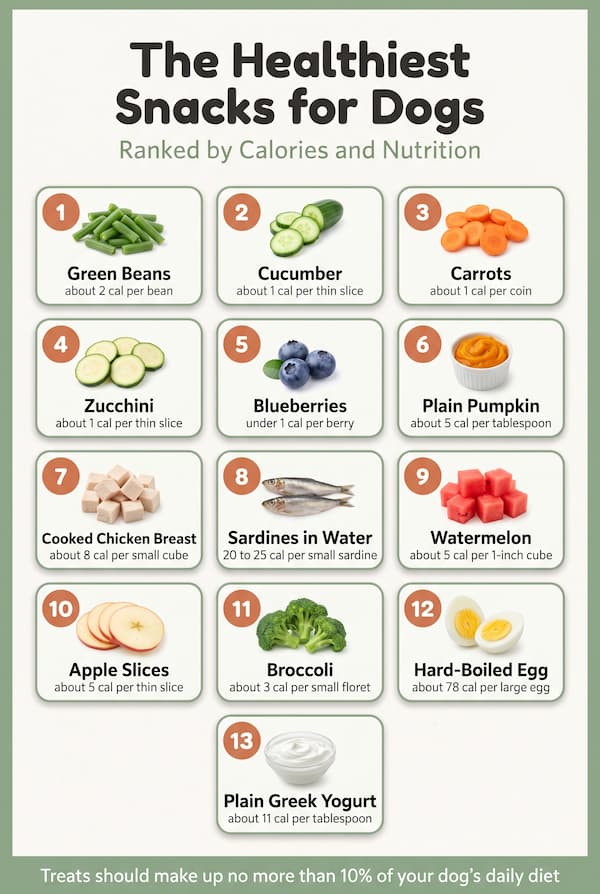
The 13 Healthiest Dog Snacks, Ranked
Every snack below is plain, unseasoned, and cut into bite-size pieces. Introduce one new food at a time, as VCA Animal Hospitals recommends, so you can spot anything that doesn’t agree with your dog.
1. Green Beans
Green beans are about 31 calories per 100 grams, which works out to roughly 2 calories per bean. They’re full of fiber and water, so they fill your dog up without adding much to the daily total.
Fresh, frozen, or canned all work. Canned only counts if the label says no salt added, because regular canned green beans carry a lot of sodium.
- Prep: Wash, trim the ends, and cut into 1-inch pieces for small dogs. Steam them lightly if raw beans give your dog gas.
- Portion: A few beans for a small dog, a small handful for a large one.
- Bonus: Frozen green beans make a cold, crunchy snack. Snickers treats them like potato chips.
2. Cucumber
Cucumber with the peel is only about 15 calories per 100 grams. One thin slice is roughly 1 calorie, and it’s mostly water.
It’s a good summer snack and a smart pick for dogs who need to lose weight but still beg like it’s their full-time job.
- Prep: Wash, slice thin, then cut slices into halves or quarters for small dogs.
- Portion: Two to four slices for small dogs, more for big ones.
3. Carrots
Carrots come in at about 41 calories per 100 grams. That’s a bit more than green beans because carrots carry more natural sugar, but they’re still one of the lowest-calorie snacks you can buy.
They bring fiber and beta-carotene, and the crunch keeps dogs busy for a moment longer than a soft treat.
- Prep: Cut into thin coins or matchsticks. Whole baby carrots can be a choking risk for small dogs and fast eaters (I learned this watching Snickers try to swallow one whole).
- Raw or cooked: Raw gives more crunch. Lightly steamed is easier on dogs who don’t digest raw veggies well.
- Portion: A few coins for small dogs, one or two baby carrots for large dogs.
I keep a bag of frozen carrot treats in the freezer for teething puppies and hot afternoons.
4. Zucchini
Zucchini is about 17 calories per 100 grams. A thin slice is around 1 calorie.
It’s mild, soft when cooked, and rarely upsets a stomach. If your dog turns their nose up at raw cucumber, try lightly steamed zucchini instead.
- Prep: Wash, slice thin, serve raw or steamed with no oil or salt.
- Portion: Same as cucumber.
5. Blueberries
Blueberries are about 57 calories per 100 grams, which means each berry is under 1 calorie. They’re small, they bring antioxidants and fiber, and they’re the perfect size for training.
The only real downside is that fruit has more sugar than veggies. VCA points out that most fruits are higher in sugar than vegetables, so don’t treat them as unlimited.
- Prep: Wash. Fresh or frozen both work. Squish them for tiny dogs.
- Portion: 5 to 10 for small dogs, a small handful for large ones.
If your dog loves them, these frozen blueberry treats are an easy weekend project.
6. Plain Pumpkin
Canned pumpkin without salt is about 34 calories per 100 grams, or roughly 5 calories per tablespoon. It’s rich in fiber, which is why so many vets suggest it for dogs with mildly loose or hard stools.
Always buy 100% pumpkin, never pumpkin pie filling. Pie filling has added sugar and spices that have no business in your dog’s bowl.
- Prep: Serve a spoonful plain, mix it into a meal, or freeze small dollops in an ice cube tray.
- Portion: About 1 teaspoon for small dogs and 1 tablespoon for large dogs.
7. Plain Cooked Chicken Breast
Roasted chicken breast is about 165 calories per 100 grams. That’s much higher than veggies, but a thumbnail-size cube (about 5 grams) is only around 8 calories, and it’s lean protein your dog will do backflips for.
This is my go-to for training and vet visits. Dogs work harder for chicken than for anything with a leaf on the package.
- Prep: Boil or bake with nothing on it. No skin, no bones, no garlic or onion powder.
- Portion: Cut into tiny cubes and count them. Three or four cubes for a small dog is plenty.
For more ideas on high-value rewards, see my guide to dog training treats.
8. Sardines Canned in Water
Sardines are one of the best natural sources of omega-3 fatty acids, which support skin and coat. The AKC notes that canned sardines packed in water can be fed without deboning, because canning softens the bones.
They aren’t low calorie, though. USDA lists drained sardines at about 208 calories per 100 grams, so one small sardine is roughly 20 to 25 calories depending on size (check your can’s label).
- Prep: Buy sardines packed in water with no added salt. Skip anything in oil, tomato sauce, or brine.
- Portion: Half a sardine for small dogs, one or two for large dogs, a couple of times a week.
9. Watermelon
Watermelon is about 30 calories per 100 grams, so a 1-inch cube is about 5 calories. It’s mostly water, with vitamins A and C, and dogs go nuts for it on hot days.
- Prep: Seedless only, and remove the rind and every seed. The rind is tough to digest and can cause a blockage.
- Portion: One or two cubes for small dogs, a few for large ones.
10. Apple Slices
Apples with the skin are about 52 calories per 100 grams, or roughly 5 calories per thin slice. They add fiber and vitamin C and have a nice crunch.
The core and seeds have to go. Apple seeds contain compounds that release cyanide when chewed, and the core is a choking risk.
- Prep: Wash, core, remove every seed, slice thin.
- Portion: One or two slices for small dogs, three or four for large dogs.
11. Broccoli
Broccoli is about 34 calories per 100 grams, so a small floret is about 3 calories. It brings vitamin C, vitamin K, and fiber.
It’s lower on the list for one reason. Too much broccoli can give dogs gas and an upset stomach, so it works best as an occasional snack, not a daily one.
- Prep: Small florets, raw or lightly steamed, with no butter or cheese sauce.
- Portion: One or two small florets for small dogs, a few for large dogs.
12. Hard-Boiled Egg
Eggs are a complete protein with biotin, riboflavin, and selenium. The AKC says eggs are safe for dogs as long as they’re fully cooked and prepared without salt, butter, or seasonings.
The catch is calories. A large hard-boiled egg is about 78 calories, which is more than double a 10-pound dog’s whole treat budget.
Honestly, most small dogs should get a slice, not the egg.
- Prep: Hard-boil, cool, peel, and chop. Skip raw eggs. Raw egg whites can interfere with biotin absorption over time, and raw eggs can carry Salmonella.
- Portion: A slice or two for small dogs, a quarter to half an egg for large dogs.
13. Plain Greek Yogurt
Plain low-fat Greek yogurt is about 73 calories per 100 grams, so one tablespoon is roughly 11 calories. It offers protein and live cultures.
It’s last because not every dog handles dairy, and the wrong tub can be dangerous. Read the label for xylitol, which sometimes shows up in sugar-free yogurts and is toxic to dogs.
- Prep: Plain and unsweetened only. No vanilla, fruit-on-the-bottom, or “light” versions with sweeteners.
- Portion: A teaspoon for small dogs, a tablespoon for large dogs. Try a tiny amount first and watch for loose stools.
Never Feed These, Even as a Treat
A healthy snack list wouldn’t be complete without the foods that can make a dog seriously sick. These come from the AKC and VCA toxic food lists.
- Grapes, raisins, and currants. Linked to sudden kidney injury in dogs.
- Xylitol (birch sugar). Found in some peanut butters, sugar-free gum, and yogurts. It can cause a dangerous drop in blood sugar.
- Onions, garlic, leeks, and chives. They damage red blood cells. AKC notes garlic is even more toxic than onion, and it sneaks into lots of “homemade” treat recipes.
- Macadamia nuts. Can cause weakness, tremors, and vomiting.
- Avocado pits and skin. Choking and blockage risk.
- Corn on the cob. The cob can block the intestines. Plain kernels are fine.
- Cooked bones. They splinter. Canned sardine bones are the soft exception.
- Rhubarb, green tomatoes, and wild mushrooms. All on VCA’s avoid list.
If you think your dog ate something toxic, call your vet or the ASPCA Animal Poison Control Center at (888) 426-4435 right away (a consultation fee may apply). Don’t wait for symptoms.
My Sunday Snack Prep Routine
Healthy snacks only work if they’re faster to grab than the bag of store treats. So once a week I prep everything in about 20 minutes and stack it in the fridge and freezer.
| Snack | How I prep it | Where it goes |
|---|---|---|
| Green beans | Trim, cut into 1-inch pieces, steam 3 minutes | Half in the fridge, half frozen on a tray then bagged |
| Carrots | Slice into thin coins | Airtight container in the fridge |
| Chicken breast | Boil plain, cool, dice into small cubes | Fridge for 3 to 4 days, the rest frozen in small bags |
| Pumpkin | Spoon into an ice cube tray | Freezer, pop out one cube at a time |
| Blueberries | Wash and dry | Freezer bag |
The trick that made it stick for me was a small jar on the counter. Every morning I fill it with that day’s snacks, measured against Snickers’ budget, and when the jar is empty, snack time is over. No guessing, no “just one more.”
Snickers Still Thinks Green Beans Are Candy
A few months later we were back on that same scale. The number had moved in the right direction, and the vet’s polite look was replaced by an actual smile.
Snickers didn’t notice any of it. He was too busy staring at my pocket, because he knows that’s where the green beans live now.
I’m a passionate dog lover and kitchen enthusiast, but I’m not a certified veterinarian or animal nutritionist. Every dog is different, so talk to your vet before making big changes to your dog’s diet, especially if they have a health condition like kidney disease, pancreatitis, or allergies.
Happy snacking to your furry friend!