The vet said it kindly. Softly, even. “So Snickers is about three pounds over ideal, Aleksandar. Nothing dramatic. But we should probably do something about it.”
I stood there holding the leash while he panted up at me, tongue out, tail going, absolutely thrilled with life. Three pounds doesn’t sound like much until you realize my Cavalier weighs 18. That’s roughly 30 extra pounds on a person.
The vet was being gentle. The math wasn’t.
The walk home was quiet on my end. I was thinking about all the times I’d tossed him a bite of chicken while cooking, broken off a corner of cheese, added an extra scoop because he “looked hungry.”
Each moment felt fine. Together, they added three pounds.
The good news is it came off. Slowly, without drama, without Snickers acting like I was starving him. Here’s what worked.
Why a Few Extra Pounds Is a Bigger Deal Than It Looks
- 59% of US dogs are overweight or obese (Association for Pet Obesity Prevention). Yours might just look “normal” because the baseline has shifted.
- Overweight dogs live up to 2.5 years less than lean ones (Banfield data). That’s a chunk of dog life left on the table.
- Joint strain, diabetes risk, and heart load all climb with excess weight. Small breeds wear their knees and hips down faster under the extra load.
- A 14-year Purina study showed dogs kept lean lived a median of 1.8 years longer than dogs fed to satisfaction. Same food. Just less of it.
None of this is meant to scare you. It’s meant to make the effort feel worth it.
At a Glance: The Formula
| Do This | Not This |
|---|---|
| Feed for target weight, not current | Bag’s chart for current weight |
| High protein, high fiber, low fat | “Weight management” kibble at same volume |
| Weigh food on a kitchen scale | Eyeball it with a coffee mug |
| Split into 2 or 3 smaller meals | One big bowl at dinner |
| Add veggies for bulk | More kibble to “fill him up” |
The single biggest lever is portion accuracy. Everything else stacks on top.
Is Your Dog Actually Overweight? The 30-Second Home Check
Skip the scale for a minute. Vets use Body Condition Score, and you can run a rough version at home in under thirty seconds.
Stand behind your dog and look down. You should see a visible narrowing at the waist, right behind the last rib. If your dog looks like a loaf of bread from above, that’s a signal.
Press gently over his ribs. You want them to feel like the knuckles on the back of your hand: clearly there, under a thin layer of skin. If they feel like the padded palm of your hand, your dog is carrying too much weight.
Look at him from the side. His belly should tuck up from chest toward hips, not hang level. Two out of three signs pointing to overweight? Time to act.
A Lean Turkey and Green Bean Weight Loss Bowl
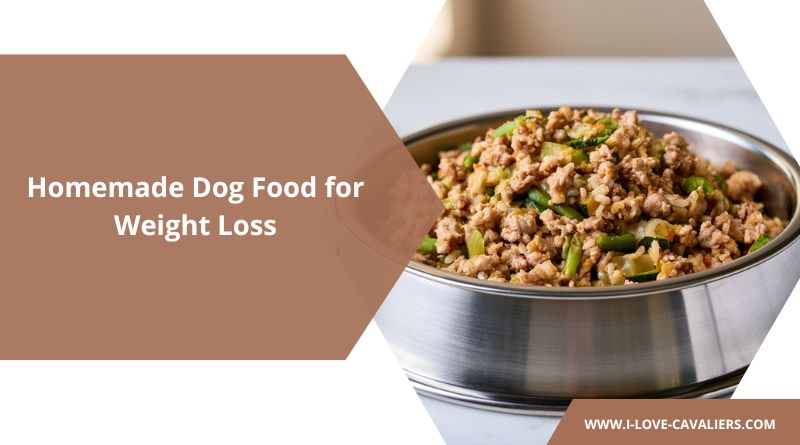
This is the recipe I built for Snickers. High protein, high fiber, low fat, with real volume so he wasn’t staring at me between meals.
Green beans are the trick. Dogs think they’re a treat, but they’re basically water and fiber. Combine them with plain canned pumpkin and you get a stomach-filler that costs almost nothing.
Ingredients
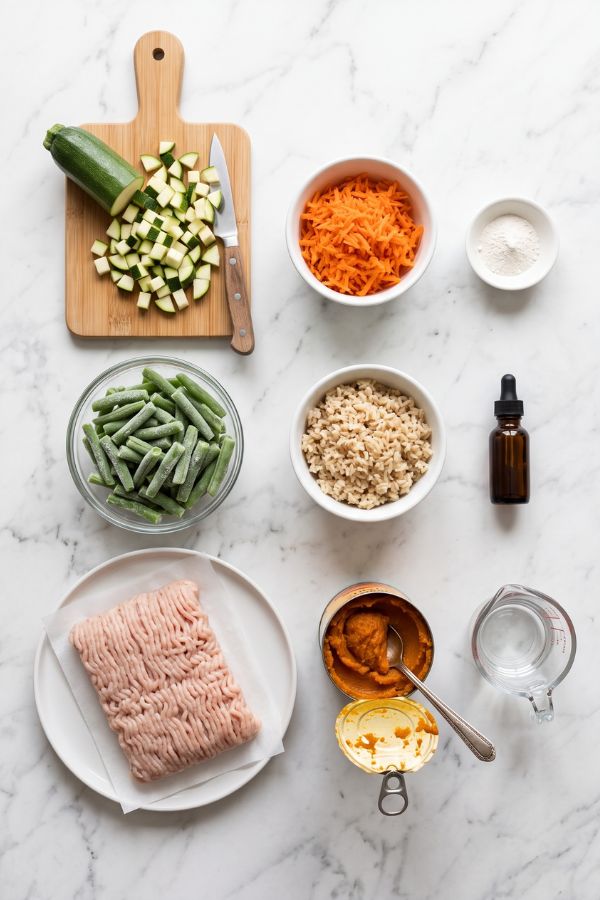
| Ingredient | Amount | Approx. Cost |
|---|---|---|
| Ground turkey breast (99% lean) | 1.5 lbs | $8.00 |
| Frozen green beans (plain, no salt) | 3 cups | $2.00 |
| Zucchini, diced | 1 large | $1.00 |
| Grated carrot | 1 cup | $0.40 |
| Plain canned pumpkin (NOT pie filling) | 1/2 cup | $0.75 |
| Cooked brown rice | 3/4 cup | $0.30 |
| Fish oil | 1 teaspoon | $0.10 |
| Calcium supplement | Per package | $0.15/day |
| Water | 2 cups | Free |
| Total | ~$12.55 + supplement |
Use the leanest ground turkey you can find. 99% lean is ideal. If you can only get 85/15, drain every drop of rendered fat after browning.
Steps by Step Instructions
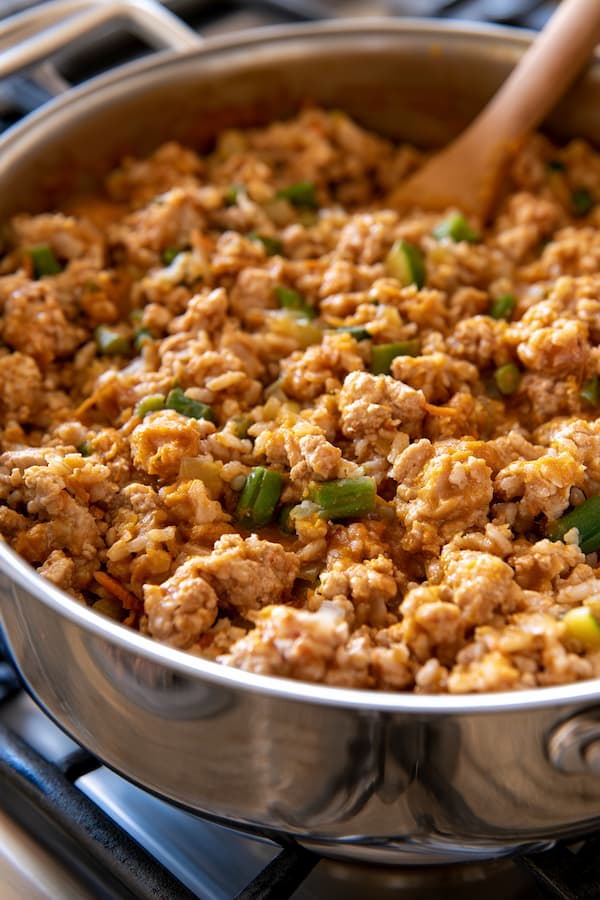
Step 1: Brown the Turkey Dry
Add the turkey to a large pot over medium heat. Do not add oil. Break the meat apart with a wooden spoon and cook until no pink remains, about 6 minutes. Drain any liquid or fat pooled at the bottom (don’t skip this, it undoes half the recipe).
Step 2: Add Rice, Pumpkin, and Water
Pour in the water, brown rice, and pumpkin. Stir until the pumpkin dissolves into the liquid and coats everything. Bring to a gentle simmer.
Step 3: Add the Vegetables
Toss in the green beans, zucchini, and grated carrot. Cover and simmer for 10 minutes. The green beans should bend but not turn to mush. Overcooked green beans lose their bulk.
Step 4: Finish and Cool
Turn off the heat and stir in the fish oil. Spread the batch on a sheet pan to cool before storing. Sealing warm food in containers creates condensation and I’ve lost a batch that way (learn from my mistake).
Storage and Serving
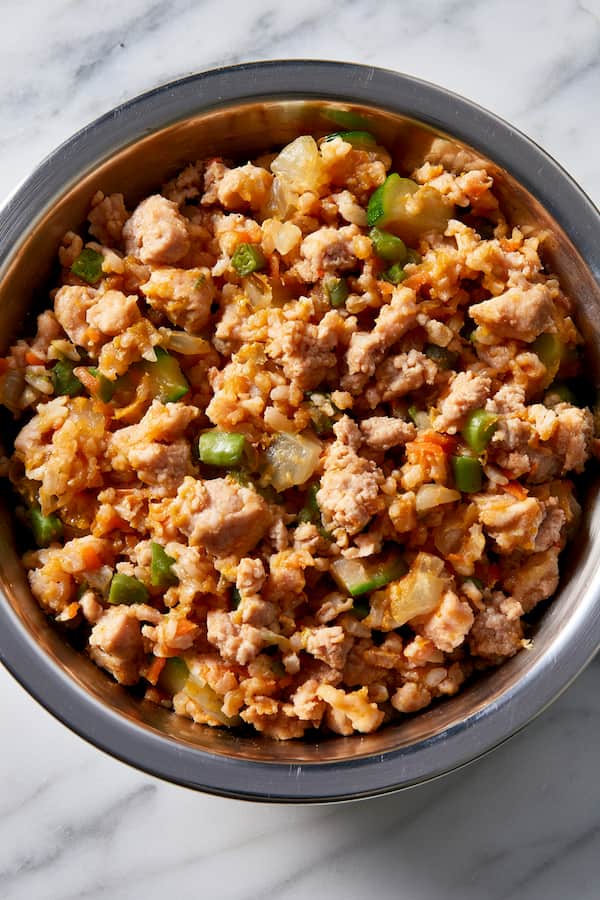
Fridge for 4 days, freezer for 2 months. This batch makes about 8 cups, roughly a week for a 15-to-25 pound dog.
| Target Weight | Daily Amount | Meals |
|---|---|---|
| 10 lbs | 3/4 cup | 2 |
| 15 lbs | 1 cup | 2 |
| 20 lbs | 1.25 cups | 2 or 3 |
| 30 lbs | 1.75 cups | 2 or 3 |
| 50 lbs | 2.5 cups | 3 |
Splitting into 3 smaller meals is my favorite trick. Same total food, way less begging.
A Real Portion Example
Say your dog is 40 pounds now but the vet says target is 34. Use 34 in the formula, not 40.
The vet formula for resting calories is: (30 × target weight in kg) + 70 = kcal per day. 34 pounds is 15.4 kg, so: (30 × 15.4) + 70 = about 532 calories per day for weight loss.
At roughly 380 calories per cup for this recipe, that’s about 1.4 cups a day, split across 2 or 3 meals. Weigh your dog every two weeks and adjust. Safe loss is 1 to 2 percent of body weight per week. Faster than that isn’t fat loss, it’s muscle loss.
The Sneaky Calorie Traps
The bowl isn’t the only problem. This is where the extra calories hide.
- Training treats. A handful can be 20 to 30 percent of daily calories. Swap for baby carrots, plain green beans, or a spoon of the recipe rolled into little balls. Our low-calorie treat guide has more ideas.
- Human food scraps. One bite of cheese while cooking is around 40 calories. Two bites a day for a 20-pound dog erases the diet.
- The hidden feeder. Ask everyone in your household what they’ve been giving the dog. Family, kids, neighbors. Snickers had a friend in the building slipping him bits of cracker for weeks before I caught on.
- Kibble on top of the recipe. Pick one method. Mixing kibble into a homemade batch doubles the calories.
Keep treats under 10 percent of daily calories and be honest about what everyone is feeding.
Back to the Vet Scale
Six months later we went back. Snickers hopped up on the scale and stood there like he owned it, tail whacking against the counter. 18.2 pounds. The vet grinned. Snickers, blissfully unaware any of this had been about him, tried to eat the corner of a chart hanging on the wall.
The whole thing was quieter than I expected. No hunger strikes, no sad eyes from the corner. Just smaller portions, better ingredients, and one very useful vegetable I’d been ignoring my whole life.
Turns out the answer wasn’t a special food. It was paying attention.
He still eats green beans out of my hand like they’re candy. I’m not going to be the one to tell him.
I’m a passionate dog lover and kitchen enthusiast, but I’m not a certified veterinarian or animal nutritionist. Long-term homemade diets and weight loss plans should always be discussed with your vet to make sure your pup is getting everything they need.
Bon appétit to your slimmer furry friend!