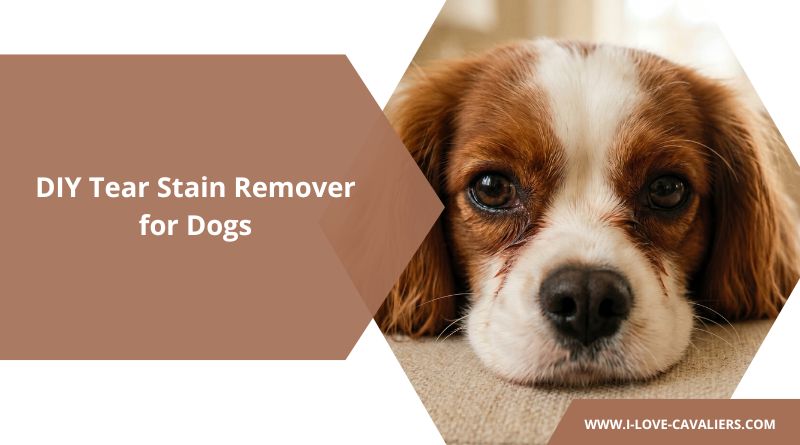
I noticed the rust-colored streaks under Snickers’ eyes one morning while I was wiping crumbs off his face. He’d had them for weeks, probably longer, and I’d just sort of stopped seeing them. Like a stain on a piece of furniture you walk past every day.
The internet, as the internet does, had a lot of advice. Some of it was sensible. Some of it would have given my dog a chemical burn near his eyes. One recipe had me mixing hydrogen peroxide and milk of magnesia and putting it within an inch of his eyeball, which (looking back) sounds like a dare.
So I dug into actual veterinary sources and groomer forums and figured out which DIY methods are safe, which ones aren’t, and what most articles miss about why those stains keep coming back. That’s what this article is.
If you’re tired of seeing those reddish-brown streaks every time your dog blinks, let’s get into it.
Quick Pick: What Actually Works on Tear Stains
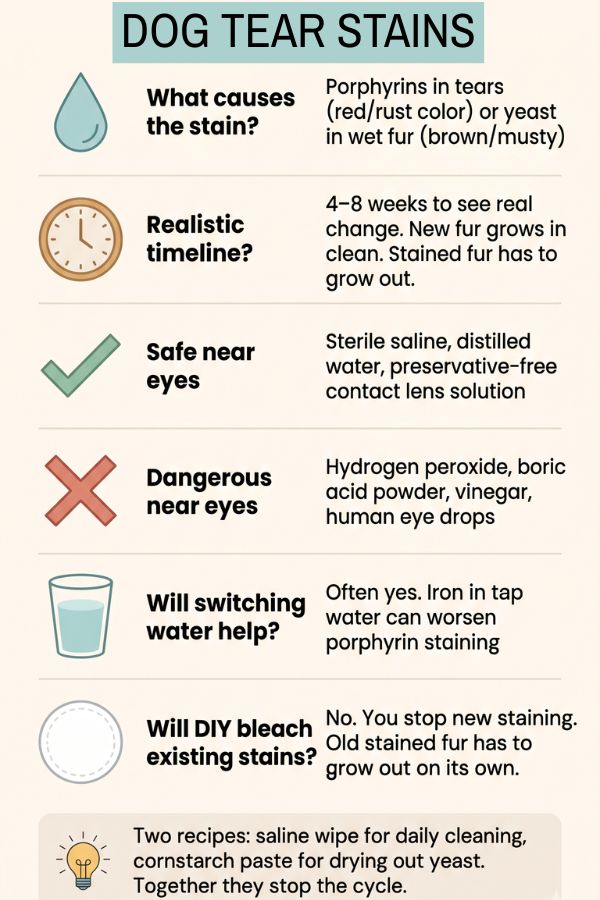
| Question | Short Answer |
|---|---|
| What causes the stain? | Porphyrins in tears (red/rust color) or yeast in wet fur (brown/musty) |
| Will DIY bleach the existing stain? | No. New fur grows in clean. Stained fur has to grow out. |
| Realistic timeline? | 4-8 weeks to see real change |
| Safe ingredients near eyes? | Sterile saline, distilled water, preservative-free contact lens solution |
| Dangerous near eyes? | Hydrogen peroxide, boric acid powder, vinegar, human eye drops |
| Will switching water help? | Often yes. Iron in tap water can worsen porphyrin staining |
The hardest truth: tear stains don’t wash out. They grow out. Daily wipes prevent new staining, but the existing stained hair has to be replaced over weeks before your dog’s face looks fully clean.
Two Kinds of Tear Stains (and Why the Difference Matters)
Most articles treat tear stains like one problem. They’re actually two, and they need different fixes.
Red or rust-colored stains come from porphyrins. Porphyrins are iron-containing waste molecules that show up in tears, saliva, and urine. When they dry on light fur and hit sunlight, the iron oxidizes and turns the fur red-brown. Dark-coated dogs have the same porphyrins, you just can’t see them. This is the most common type of tear stain.
Brown or musty-smelling stains come from yeast (Malassezia). Yeast grows in chronically wet fur and produces its own pigment plus a yeasty odor. If you can smell something a little funky in the corner of your dog’s eye, that’s yeast.
You can have both at once. In fact, most chronic tear-stain dogs do. Treating only the porphyrins while ignoring the yeast leaves half the stain behind. That’s why so many owners say nothing works for them.
What You Should Never Put Near Your Dog’s Eyes
A lot of the recipes floating around online are flat-out dangerous. Skip every one of these.
- Hydrogen peroxide. Even diluted, it can cause chemical burns and serious eye damage if it splashes. There’s a reason eye washes use saline, not peroxide.
- Full-strength boric acid powder. AKC and most vets warn against home-mixed boric acid solutions. The pre-formulated eyewash version is different, but loose powder is a no.
- Apple cider vinegar. It’s a great repellent for fleas on fur, but it’s strongly acidic. Anywhere near the eye is irritating, painful, and can damage the cornea.
- Human eye drops or Visine. Wrong pH, wrong active ingredients, formulated for human tear chemistry.
- Lemon juice. Same problem as vinegar. Acidic and irritating.
- Essential oils. Not even diluted. Eyes are a no-go zone for any essential oil.
If a recipe says to mix anything bubbly, anything that stings on a paper cut, or anything that has a strong chemical smell, don’t put it near your dog’s face. The eye is a delicate organ and the cost of getting it wrong is huge.
The Daily Wipe: The Foundation of Every Plan
Before you mix anything fancy, get this part right. A daily wipe with the right liquid prevents 80% of new staining.
Wet a soft cotton ball or fragrance-free cotton round with sterile saline or distilled water. Wipe gently under and around each eye, always away from the eye, not toward it. Use a fresh side of the cotton for each pass. One eye, one cotton round.
Do this twice a day during active treatment, once a day for maintenance. Morning is the most important wipe because porphyrins darken with sunlight exposure, so cleaning the face before your dog goes outside in the day reduces how dark the new staining sets.
This sounds boring but it’s the single highest-impact thing you can do. Skip the recipes if you have to. Don’t skip the daily wipe.
Recipe 1: Saline Eye-Safe Wipe Solution
This is your everyday wipe solution. It’s gentle, eye-safe, and you can use it indefinitely.
Ingredients
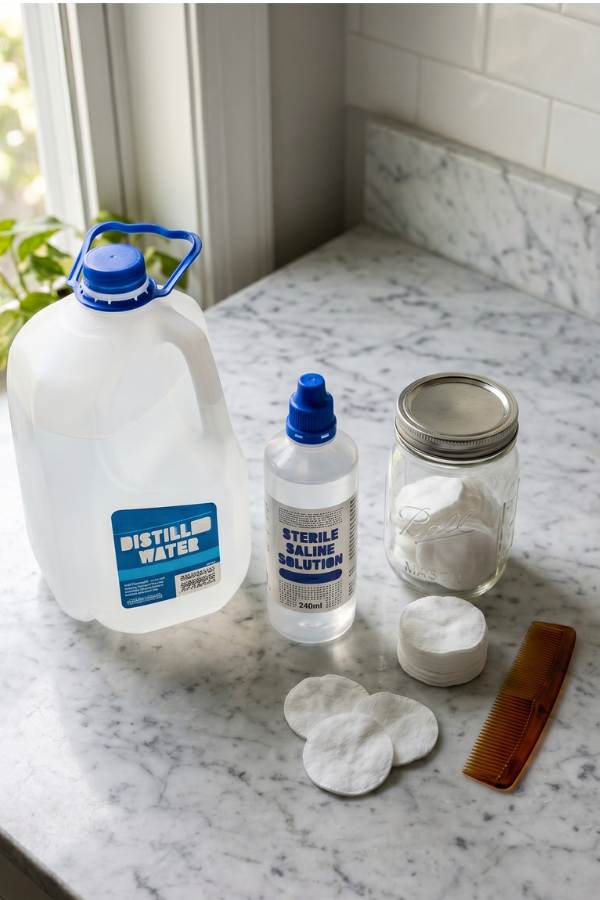
| Ingredient | Amount | Notes |
|---|---|---|
| Sterile saline solution | 1 cup | Same as contact lens saline, preservative-free if possible |
| Distilled water | 1/2 cup | Don’t substitute tap water |
| Glass jar with lid | 1 | For storage |
Steps
- Combine the saline and distilled water in a clean glass jar.
- Shake gently to mix.
- Soak a fresh cotton round each morning and evening.
- Wipe under each eye, working from the inner corner outward, away from the eyeball.
- Pat the area completely dry with a clean cotton round. Damp fur is what feeds yeast.
- Store in the fridge between uses. Replace the solution every 3-4 days.
If the area smells musty, that’s the yeast component. You’ll need to address that with the cornstarch step below.
Cool the solution slightly in the fridge before using. Most dogs find a slightly cool wipe easier to tolerate than a room-temperature one.
Recipe 2: Cornstarch Drying Paste (Fur Only, Not Skin)
This one is for the yeast side of the problem. It dries out the chronically wet fur where yeast lives. Apply it only to the stained fur, never to the skin itself, and never close enough to the eye that it could fall in.
Ingredients
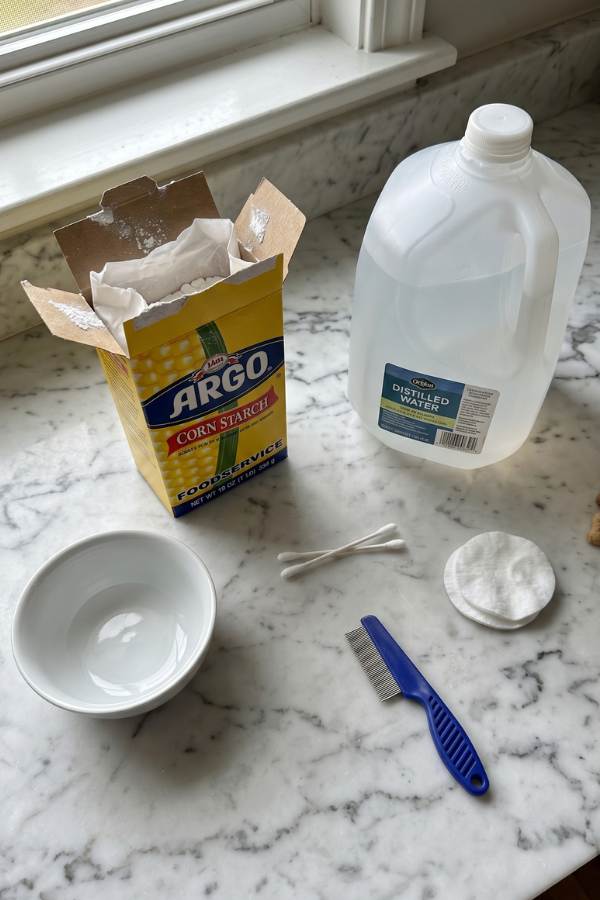
| Ingredient | Amount | Notes |
|---|---|---|
| Plain cornstarch | 2 tablespoons | The baking aisle kind |
| Distilled water | Just enough to form paste | Few drops at a time |
| Small bowl and cotton swab | For mixing and applying |
Steps
- Spoon the cornstarch into a small bowl.
- Add distilled water a few drops at a time, mixing with a clean cotton swab, until you get a thick paste.
- Using the cotton swab, dab the paste only onto the stained fur, well below the eyelid.
- Let it sit for 5 minutes. Your dog will probably try to rub it off. Hold them or distract with a treat.
- Gently comb the dried cornstarch out with a fine-toothed comb. The cornstarch absorbs moisture and lifts some of the yeast residue with it.
- Wipe the area clean with the saline solution from Recipe 1.
- Apply once a day for two weeks, then taper to twice a week for maintenance.
This won’t bleach the stain out. What it does is dry the area enough that the yeast can’t keep growing, which lets the fur dry out and stop adding new color to itself.
I tried this on Snickers for the first time and he sat there looking at me like “what fresh nonsense is this,” but he stayed still for the treat. After about three weeks the musty smell was gone.
Fix the Cause, Not Just the Stain
This is what almost no article tells you up front. Topical treatment only fights yesterday’s stain. To stop tomorrow’s, you have to deal with what’s actually making your dog’s eyes water and produce porphyrins.
Switch to Filtered or Distilled Water
Tap water in many areas has iron and other minerals that contribute to porphyrin load. Dogs that switch to filtered or distilled drinking water often show noticeably less staining within 6-8 weeks. This isn’t a fluoride thing (despite what some articles claim). The mechanism is reduced dietary iron getting into the porphyrin cycle.
Swap Plastic Bowls for Stainless Steel or Ceramic
Plastic bowls develop micro-scratches over time that harbor bacteria. That bacteria irritates the face, increases tearing, and feeds the cycle. Stainless steel or ceramic are easier to keep clean and don’t scratch the same way. Wash bowls daily with hot soapy water.
Look at the Food
Tear staining can be a low-grade allergy reaction. Common triggers include chicken, beef, wheat, corn, and dairy. Switching to a single-protein diet (fish, lamb, or duck) for 8-12 weeks tells you whether food is part of the issue. If staining drops noticeably, you’ve found a piece of the puzzle.
Cheap kibble with artificial dyes, beet pulp, by-products, and high ash content tends to make staining worse. The link between diet and staining is well-documented. If you want to think about overall diet quality, look at the foods vets quietly recommend adding to your dog’s bowl for some easy upgrades.
Don’t Ignore the Teeth
Saliva also carries porphyrins. Dogs with poor dental health have higher salivary porphyrin output, which shows up as muzzle and beard staining and contributes to tear staining when the dog grooms its face. A dental cleaning or regular tooth brushing makes a measurable difference on chronic stains.
Check for Allergies
If your dog also licks her paws, scratches her ears, or has chronic skin redness, that’s a sign her body is in a low-grade inflammatory state. That inflammation drives tearing. Look at natural remedies for dog allergies for the most common triggers and what to try first.
The Sunlight Trick Almost No One Talks About
Porphyrins darken with light exposure. The longer fresh tear residue sits on the fur in daylight, the deeper the stain sets.
This is why the morning wipe matters more than the evening one. Cleaning the face before your dog goes out in the sun limits how dark today’s staining will set into the fur. Owners who wipe only at night and then send the dog outside for hours often see darker staining than owners who reverse that order.
Wipe before sunrise activity. Wipe again before bed. Both matter, but morning matters more.
How Long Will This Actually Take?
Expectations matter, because most owners quit at week two.
Here’s the realistic timeline for the combined daily wipe + cornstarch + water swap + diet review approach.
| Week | What to Expect |
|---|---|
| 1-2 | No visible change. New staining slowing down (you won’t see this). |
| 3-4 | Yeasty smell fading. Skin underneath looking cleaner. |
| 5-8 | New fur growing in clean. Existing stained fur still visible. |
| 9-12 | Clear improvement as stained fur grows out. |
| 3-4 months | Most dogs reach near-clean status if root causes are addressed. |
If you quit at week two because “nothing’s happening,” you’ve stopped right before the moment when things start happening. Stick it out.
I’m a passionate dog parent who has spent way too long down the tear-stain rabbit hole, but I’m not a veterinarian or certified canine ophthalmologist. If your dog’s tear staining appeared suddenly, is paired with eye discharge, or seems painful, please skip the DIY and see your vet first.
Happy face-wiping!