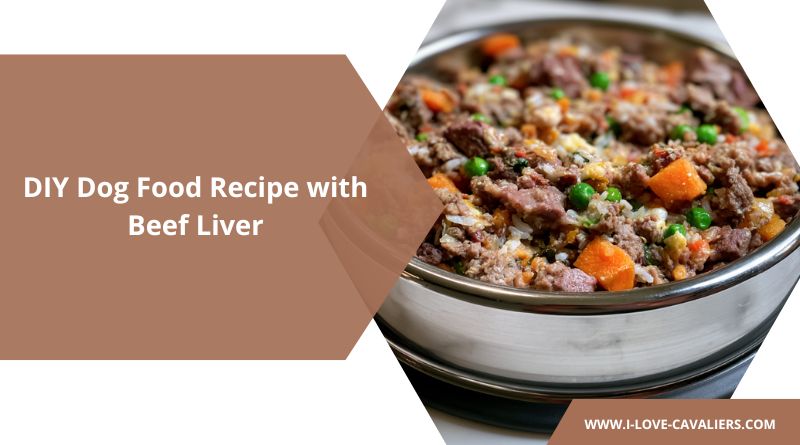
The butcher slid the paper-wrapped bundle across the counter and shrugged. “Two dollars a pound. Nobody wants it.”
I’d asked for beef liver on a whim. Snickers, my Cavalier, had been turning his nose up at his fancy “premium” kibble for almost a week. The bag cost me $68. The look on his face when I poured it into the bowl said no thanks.
So I went home with a pound of dark, glossy beef liver and a vague memory of my grandmother frying it for our family dog when I was a kid. That dog lived to seventeen. I figured she knew something I didn’t.
What I learned over the next few weeks turned into the recipe below. It’s the one I actually cook. The one Snickers spins in circles for. And the one that costs me less per day than the kibble he was refusing.
Why Beef Liver Belongs in Your Dog’s Bowl
- It’s the most nutrient-dense food you can put in a bowl. Per 100 grams, beef liver packs more iron, copper, B12, and Vitamin A than almost any other whole food on the planet. We’re talking 27g of protein and over 16,000 IU of Vitamin A in a portion smaller than your palm.
- It costs almost nothing. Most butchers practically give it away because human shoppers don’t buy it. Asian and ethnic grocery markets sell it for under $2/lb in most cities.
- Dogs go genuinely feral for it. Picky eaters who turn away from kibble will sprint across a kitchen for seared liver. I’ve tested this.
- It fixes the “shiny coat” problem. The copper and B-vitamins in liver are what your dog’s body needs to make a healthy coat. Snickers’s fur turned glossier in about three weeks.
The catch is that liver is so rich in Vitamin A that you can’t just feed it like ground beef. There’s a ceiling. We’ll get to it.
How to Make Beef Liver Dog Food
The whole process takes about 35 minutes, most of it hands-off while the rice cooks.
Ingredients
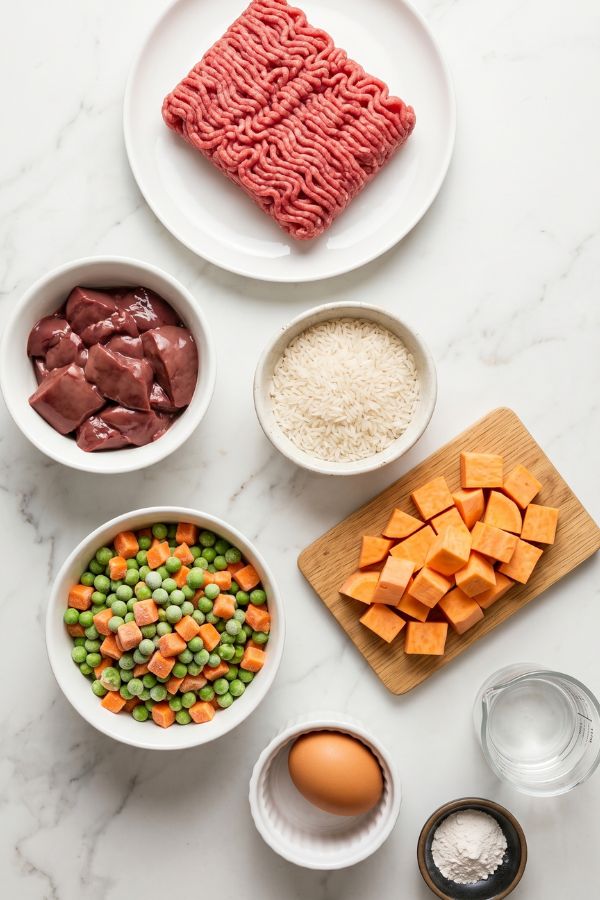
| Ingredient | Amount | Why It’s In There |
|---|---|---|
| Lean ground beef (90/10 or leaner) | 1 lb | Main protein, easy to digest |
| Beef liver, fresh | 4 oz (¼ lb) | Nutrient powerhouse, the star |
| White rice (uncooked) | 1 cup | Gentle carb, settles stomachs |
| Sweet potato, peeled and cubed | 1 medium | Fiber, beta carotene, natural sweetness |
| Frozen peas and carrots | 1 cup | Vitamins, fiber, color |
| Whole egg | 1 large | Complete protein, good fats |
| Ground eggshell powder | ½ tsp | Calcium (this matters more than you think) |
| Water | 2½ cups | For cooking the rice and softening everything |
A note on the eggshell powder. Roughly 95% of homemade dog diets fail on calcium, not protein or vitamins, per a 2025 Texas A&M study of over 1,700 real-world dog meals. Add the eggshell. It costs nothing and it’s the single most important supplement in the bowl. (More on how to make it below.)
Step 1: Prep the Liver
Rinse the beef liver under cold water and pat it dry with a paper towel. Trim off any thick membrane or connective tissue with a sharp knife.
Dice it into roughly pea-sized pieces. The smaller the dice, the more evenly the liver distributes through the batch. This is what keeps any single bowl from going over the 10% ceiling.
If the smell bothers you (it bothered me), open a window. Snickers thinks it’s the best smell on earth.
Step 2: Brown the Ground Beef
Heat a large skillet over medium. No oil needed — the beef has plenty of its own fat. Add the ground beef and break it up with a wooden spoon.
Cook for about 6–8 minutes, until no pink remains. Don’t drain the fat. Your dog needs those calories, and we’re not seasoning this, so there’s nothing weird in there.
Step 3: Add the Liver
Toss the diced liver into the same pan with the beef. Stir-fry for 3–4 minutes, until the liver pieces are uniformly brown on the outside. They should still be slightly pink in the middle, which keeps the texture tender (and keeps the B-vitamins from cooking off too aggressively).
Pour the meat mixture into a large mixing bowl and set aside.
Step 4: Simmer the Rice and Sweet Potato
In the same skillet (or a pot), combine the rice, cubed sweet potato, and 2½ cups of water. Bring to a boil, then drop to a simmer and cover.
Let it cook for about 18 minutes. The rice should be soft and the sweet potato should mash easily with a fork. If you’ve got extra liquid, that’s fine. It’ll absorb as it cools.
Step 5: Wilt the Veggies and Crack the Egg
In the last 3 minutes of rice cooking, dump the frozen peas and carrots right on top of the rice. Cover and let the steam wilt them. Crack the egg in too. Stir it through. The residual heat cooks it in about a minute.
I learned this trick after washing way too many extra pans. One skillet, the whole meal.
Step 6: Mix Everything Together
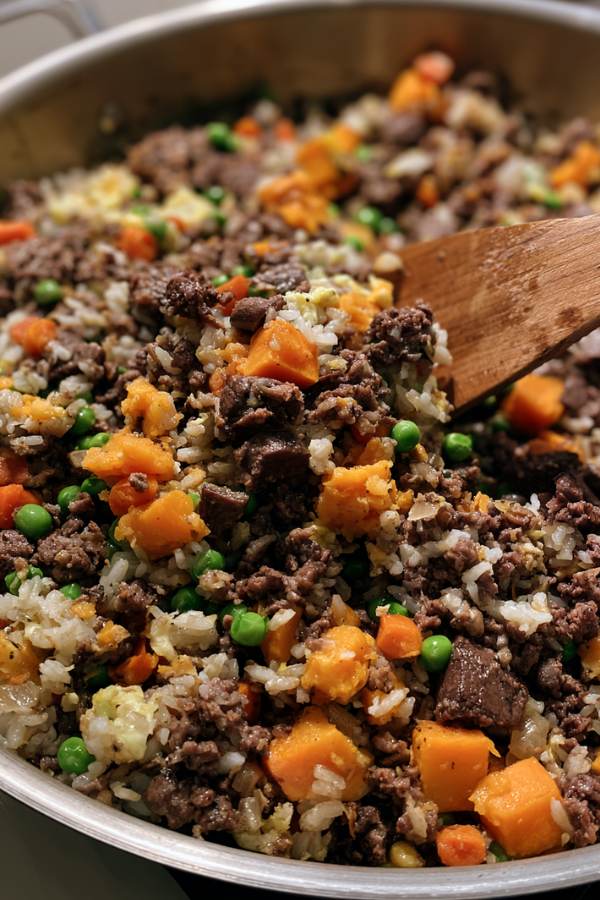
Pour the rice mixture into the bowl with the meat. Sprinkle in the ground eggshell powder. Stir it all together with a wooden spoon until everything’s evenly distributed.
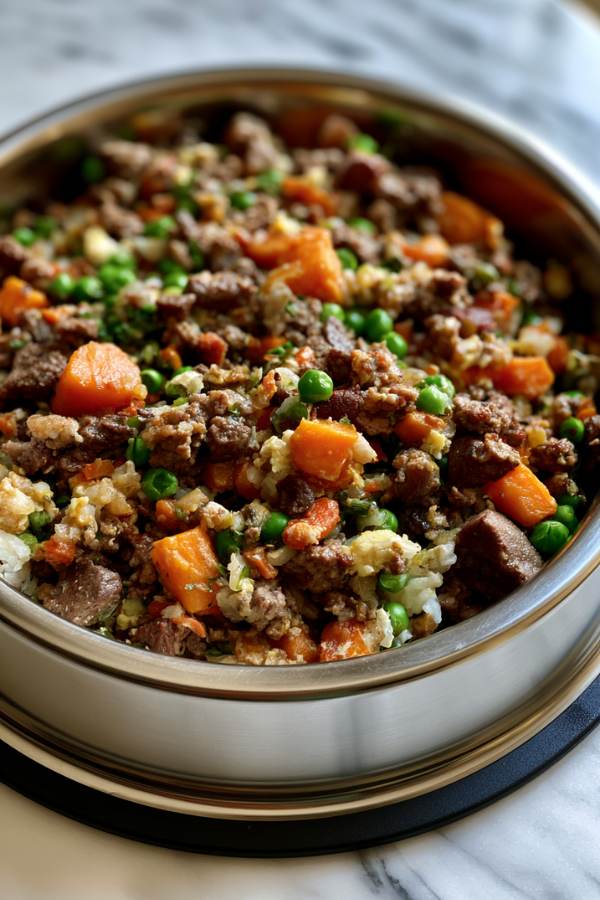
It should look like a slightly sticky, savory hash. Smell it once and pat yourself on the back — that’s real food.
Step 7: Cool and Portion
Spread the mixture on a sheet pan to cool quickly (it cools in about 20 minutes that way). Then portion into containers based on your dog’s weight (see the serving table below).
I use 5 small glass containers, one per day. The 6th portion goes straight into the freezer.
The 5%/10% Rule
Beef liver contains around 16,898 IU of Vitamin A per 100 grams. For comparison, the same weight of ground beef has basically zero. So liver isn’t food in the normal sense. It’s more like a food + a supplement smashed together.
Vitamin A is fat-soluble, which is fancy talk for “your dog can’t pee it out.” It builds up in the body over time. Too much, for too long, causes joint pain, brittle bones, and liver damage. (Yes, the irony of liver causing liver damage is not lost on me.)
The safe ceiling is 5–10% of the total diet, max. Most vet nutritionists, including the authors of the VCA Hospitals homemade diet guidelines, sit right in that range.
For a 30-lb dog eating roughly 2 cups of food per day, that means no more than 2 oz of beef liver per week, total. The recipe above contains 4 oz in 5 daily portions, which puts each bowl at right around 7% — safely inside the line.
If you scale the recipe up or down, scale the liver with it. Don’t just dump in more “because it’s healthy.” That’s how dogs end up at the vet with hypervitaminosis A.
The Calcium Fix Nobody Talks About
Meat and organs are loaded with phosphorus and almost no calcium. Bones balance that out in nature. In a kitchen, you have to add the calcium yourself.
The Texas A&M Dog Aging Project looked at 1,726 real homemade dog diets in 2025. Over half were missing 10 or more nutrients. The single most common gap was calcium — and the most common consequence is a condition called “rubber jaw,” where the bone literally softens because the body steals calcium from itself.
The fix takes thirty seconds.
Eggshell powder method: Rinse and dry eggshells. Bake at 300°F for 10 minutes to kill anything biological. Grind in a clean coffee or spice grinder until it’s a fine powder. One teaspoon equals roughly 2,000 mg of calcium.
Your ratio: ½ teaspoon of eggshell powder per pound of meat in the recipe. For the batch above (1 lb beef + ¼ lb liver = 1.25 lbs), that’s about ½ teaspoon, which is what the ingredient list calls for.
Skip it and you’re feeding an incomplete meal. Add it and you’ve solved the #1 problem with homemade dog food in one step.
Storage and Daily Serving Size
Cooled and portioned, this batch keeps for 4 days in the fridge in airtight containers and 3 months in the freezer in flat freezer bags. Freezer bags squish flat and thaw fast, which is why I prefer them over big tubs.
| Dog Weight | Cups Per Day | Calories (approx) |
|---|---|---|
| 10 lbs | ⅔ cup | ~220 |
| 20 lbs | 1 cup | ~330 |
| 30 lbs | 1¼ cups | ~415 |
| 50 lbs | 2 cups | ~660 |
| 70 lbs | 2½ cups | ~825 |
| 90 lbs | 3 cups | ~1000 |
These are starting points. Watch your dog’s weight over 2–3 weeks and adjust. A good rule: you should be able to feel the ribs without seeing them. If you can’t feel them, cut the portion by 10%. If you can see them, add 10%.
Senior dogs and couch-potato dogs need less. Working dogs and puppies need more. Snickers gets about 1¼ cups split into two meals, which lines up almost exactly with the chart.
For more weight-management context, check out our guide on figuring out if your dog is carrying extra weight.
If Your Dog Won’t Touch the Liver
This almost never happens, but when it does, here’s what actually works.
Sear it harder. Most picky dogs reject boiled liver because boiling makes it mushy and bland. Pan-searing it dry for 4–5 minutes per side gives it that caramelized, almost-charred smell that bypasses every dog’s “is this weird?” instinct. Sear, don’t simmer.
Mix the first few bowls with something familiar. If your dog’s been on kibble, do 75% kibble + 25% homemade for 3 days. Then 50/50. Then 25/75. Then full homemade. Sudden swaps cause loose stools (trust me on this one).
Use bone broth as a bridge. Pour a tablespoon of unsalted bone broth over the bowl. The smell does most of the convincing.
Freeze-dried liver as a topper. If even seared liver gets rejected, sprinkle a small amount of freeze-dried beef liver on top of the bowl. Almost no dog says no to that.
The first time Snickers ate this, he inhaled it in under a minute and stared at the bowl like it had betrayed him by being empty. That’s the response you’re aiming for.
Transitioning from Kibble (7-Day Schedule)
Switching cold-turkey is the fastest way to a carpet-cleaning emergency. Spread it over a week instead.
| Day | Kibble | Homemade |
|---|---|---|
| 1–2 | 75% | 25% |
| 3–4 | 50% | 50% |
| 5–6 | 25% | 75% |
| 7+ | 0% | 100% |
If you see soft stool at any stage, hold that ratio for an extra day or two before moving on. There’s no rush.
What This Actually Costs
I added up the price of one batch the last time I made it:
- Ground beef (1 lb, sale price): $4.50
- Beef liver (¼ lb): $0.50
- White rice (1 cup): $0.20
- Sweet potato: $0.80
- Frozen peas and carrots (1 cup): $0.50
- Egg: $0.30
- Eggshell powder: free
Total: about $6.80 for 5 days of food for a 30-lb dog. That’s roughly $1.36 per day.
The “premium” kibble Snickers refused worked out to $2.27 per day, and he wasn’t eating it. So fresh, homemade, with organ meat, came out cheaper than the bag I was throwing away.
If you want more cost breakdowns like this, I went deeper in our piece on why homemade dog food is cheaper than kibble. The numbers will surprise you.
The First Bowl
The first time I served this, Snickers sat at the kitchen counter while I scooped a portion into his bowl. He didn’t beg. He just stared, that deep-eyed Cavalier stare, like he was already sure of what was about to happen.
I set the bowl down. He didn’t lift his head until it was empty. Then he licked the floor under the bowl. Then he licked the bowl again, just to be sure.
He’s been eating some version of this recipe for over a year now. His coat is glossier, his stools are firmer, his teeth are cleaner, and the only thing he still turns his nose up at is the empty bowl.
I’m a passionate dog lover and kitchen enthusiast, but I’m not a certified veterinarian or animal nutritionist. Long-term homemade diets should always be discussed with your vet to make sure your pup is getting everything they need, especially when adding organ meats like beef liver.
Bon appétit to your furry friend!