
It was 11 PM on a Tuesday when Snickers lost it at a plastic bag blowing across the yard. Not a person. Not another dog. A plastic bag. I was already in bed, half asleep, and suddenly he’s at the window going full alarm mode like we’re under siege.
I did the thing you’re not supposed to do. I yelled “QUIET!” from the bedroom. He barked louder. I yelled again. He matched my energy. We were basically having a shouting match, and I was losing to a dog who weighs less than my backpack.
That was the night I realized I had no actual plan for this. I’d been winging it for months, sometimes ignoring him, sometimes scolding him, sometimes bribing him with treats. None of it stuck because I wasn’t being consistent about any of it.
So I started reading. Talked to our vet. Watched way too many training videos. And slowly, over about three weeks, things changed. Snickers still barks. He’s a dog. But he stops when I ask him to, and the midnight plastic bag concerts are over.
Here’s everything I learned, step by step.
Quick Look: Which Method Works Best
| Barking Type | Best Method | How Long It Takes |
|---|---|---|
| Alert barking (doorbell, strangers) | “Speak/Quiet” command | 2-4 weeks |
| Attention/demand barking | Full ignore + reward silence | 3-6 weeks |
| Boredom barking | Exercise + enrichment | Days (once routine sticks) |
| Anxiety barking (home alone) | Desensitization + vet help | 4-8 weeks |
| Window barking | Block the view + redirect | Immediate to 2 weeks |
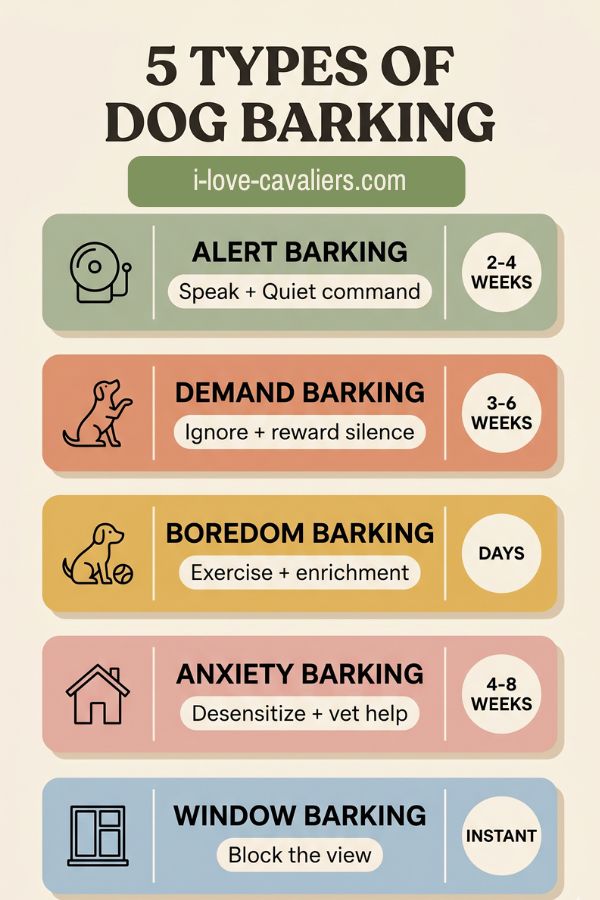
If you’re short on time, start with the “Speak/Quiet” method below. It works for the widest range of barking types and it’s what finally clicked for Snickers.
Why Barking Training Actually Matters
A quick note before we get into the how. This isn’t just about your sanity (though that matters too).
- Your neighbors have limits. Excessive barking is the number one noise complaint about dogs. In apartments, it can lead to actual eviction threats. I’ve read forum posts from people who had 10 days to fix it or move out.
- Your dog is stressed too. Barking isn’t fun for them either. Research by animal behaviorist Sophia Yin found that much of dog barking comes from internal conflict, not intentional communication. Your dog isn’t trying to annoy you. They’re stuck between wanting to flee and wanting to stand their ground.
- It gets worse if you ignore the problem. Barking is self-rewarding. The physical act of barking releases tension and feels good to the dog. So without training, it tends to escalate over time.
- Training builds your relationship. A dog who understands what you’re asking is a calmer, more confident dog. And you stop resenting each other.
Step 1: Figure Out Why Your Dog Is Barking
You can’t fix what you don’t understand. And different barks need completely different approaches. Treating them all the same is the fastest way to get nowhere.
Here’s a quick breakdown.
Alert or Territorial Barking
Your dog hears or sees something and sounds the alarm. Stiff body, ears forward, usually at a window or door. This is the “someone’s here!” bark.
Demand Barking
Your dog wants something. Food, attention, the toy under the couch. This bark is usually aimed directly at you, often with intense eye contact. It’s the “hey, I’m talking to you” bark.
Boredom or Frustration Barking
Repetitive, almost rhythmic barking that happens when your dog has nothing to do. Often paired with pacing or destructive behavior. Dogs who get less than 30 minutes of daily exercise are significantly more likely to bark excessively.
Anxiety Barking
Happens when you leave, or when something scares them. High-pitched, sometimes mixed with whining or howling. This one needs the most patience.
Once you know the type, you can pick the right tool. Trying to “quiet command” your way out of separation anxiety won’t work. And ignoring alert barking just makes your dog bark harder because they think you didn’t hear them.

Step 2: The “Speak/Quiet” Method (The One That Actually Works)
This sounds backwards, but stay with me. You teach your dog to bark on command first. Then you teach them to stop on command. It’s counterintuitive, but it works because you can’t teach “off” if you never taught “on.”
I tried three different methods before this one actually clicked for Snickers.
Teaching “Speak”
- Find your dog’s trigger. For Snickers, it was a knock on the door. For your dog, it might be the doorbell, a squeaky toy, or someone walking past the window.
- Trigger the bark, then mark it. The moment your dog barks, say “Speak!” in a clear, upbeat voice and give a treat immediately.
- Repeat 10-15 times per session. Keep sessions under 10 minutes. You can do multiple sessions a day.
- Test without the trigger. After a few days, say “Speak!” without the trigger. If your dog barks, you’re ready for the next part. If not, keep practicing.
Teaching “Quiet”
- Cue the bark. Say “Speak!” and let your dog bark 2-3 times.
- Hold a treat in your closed fist near their nose. Your dog will stop barking to sniff. The second they go silent, say “Quiet” and open your fist.
- Extend the silence gradually. Start by rewarding 1 second of silence. Then 3 seconds. Then 5. Then 10. Don’t rush this part (trust me on this one).
- Practice at each level for 10-20 reps before moving to the next duration. The ASPCA recommends this progression specifically.
- Add real distractions slowly. Practice with a friend knocking on the door. You’ll need about 10 practice visits with the same person before your dog performs reliably with real visitors.
The treat-in-fist method felt silly the first time I tried it. But it was the first thing that actually got a few seconds of silence I could reward.
Timeline
Don’t expect overnight results. Basic response might show up within a few days, but reliable “Quiet” in real situations takes 2-4 weeks of consistent daily practice. Some dogs take longer. That’s normal.
Step 3: Fixes That Don’t Need Any Training
Some barking problems have environmental solutions. No commands required.
Window Barking
If your dog loses it every time someone walks past the window, block the view. Frosted privacy film costs a few dollars and takes five minutes to apply. I’ve seen people on forums say this one change eliminated an entire category of barking overnight. Zero training needed.
Home-Alone Barking
A white noise machine or classical music playing while you’re gone can make a real difference. It masks the outside sounds that trigger alert barking when your dog is alone. SPCAs actually recommend this.
Pro tip: Leave the music or white noise running before you walk out the door, not after. If it only turns on when you leave, your dog associates it with you being gone, which can make anxiety worse.
The Exercise Factor
A tired dog is a quiet dog. Not always, but often enough that it’s worth mentioning. If your dog isn’t getting at least 60-90 minutes of activity a day, begin there before you start training. Under-exercised dogs fail every barking protocol because they’ve got energy that has to go somewhere.
A good walk plus some mental enrichment through food can take the edge off better than any command.
Step 4: What to Do for Specific Situations
Now that you’ve got the fundamentals, here are targeted fixes for the situations that drive people the most crazy.
Doorbell Barking
This is alert barking at its peak. Your dog thinks they’re doing their job.
- Have a friend ring the doorbell or knock.
- Let your dog bark 2-3 times, then say “Quiet” and hold up a treat.
- When they stop, reward immediately.
- Add a “Go to your spot” command. Pick a spot at least 8 feet from the door. Your dog can’t bark-lunge at the door while lying on a mat across the room.
- Practice this at least 10 times with the same helper before expecting it to work with real visitors.
Demand Barking (The Hardest One)
This is where most people fail. Your dog barks at you, and eventually you give in. Even once. That one time teaches your dog that barking works if they just keep at it long enough.
The fix is brutal but simple. Ignore it completely. No eye contact, no talking, no touching, no sighing, no leaving the room dramatically. Nothing.
Here’s the catch. It gets worse before it gets better. This is called an extinction burst, and it can last anywhere from 3-7 days.
Your dog will bark louder and longer because what used to work suddenly isn’t working. If you cave during the burst, you’ve just taught your dog that extra-loud barking is what it takes. You’re back to square one.
Everyone in your household has to be on board. If one person ignores the barking and another person gives in, your dog learns to target the weak link. I’ve seen this play out in every dog forum I read.
Apartment Living
Your neighbors can hear everything. You don’t have the luxury of a long extinction burst at 6 AM.
- Start training on a weekend when you have the most flexibility.
- Talk to your neighbors. Let them know you’re actively working on it. Most people are patient if they know you’re trying.
- Use the environmental fixes first. Window film, white noise, extra exercise.
- For demand barking, start your ignore training during the afternoon when noise is less of an issue.
Step 5: What NOT to Do (These Make It Worse)
Those were the practical fixes. Now here’s what to avoid, because some of the most common advice is actually the worst advice. Let me save you the trial and error.
- Don’t yell. Your dog thinks you’re barking with them. You’re joining the party, not stopping it.
- Don’t use a spray bottle. I read a post from someone who tried this for two weeks. Their dog got scared of them every time they went near the kitchen sink. Still barked at everything else.
- Don’t use bark collars as your first option. Dogs go “collar-wise.” They learn to only stop barking while the collar is on and resume the moment it’s off. The ASPCA specifically warns against collars for anxiety barking because punishment on top of fear makes things worse.
- Don’t punish inconsistently. Allowing some barking and punishing other barking confuses your dog completely. Pick a rule and stick to it.
- Don’t muzzle your dog to stop barking. Especially unsupervised. This is dangerous and doesn’t address the cause at all.
Step 6: When Nothing Is Working
If you’ve been consistent for 4-6 weeks and you’re still not seeing improvement, it’s time to escalate. This isn’t failure. Some dogs need more help.
- Talk to your vet. Rule out pain or medical issues. Dogs sometimes bark more when they’re hurting and can’t tell you.
- Ask for a referral to a certified animal behaviorist. Not just any trainer. Look for CAAB or DACVB credentials. These are people with actual degrees in animal behavior.
- Consider medication for anxiety cases. If your dog’s barking is rooted in separation anxiety or fear, anti-anxiety medication combined with training is more effective than either alone. Your vet can guide this.
There’s no shame in getting help. Some barking problems are bigger than a YouTube video can solve. A good diet can also play a role in your dog’s overall stress levels, so make sure you’re covering the basics of what your dog actually needs nutritionally.
Frequently Asked Questions
How long does it take to train a dog to stop barking?
It depends on the type of barking and how consistent you are. Alert barking can improve in 2-3 weeks with the Speak/Quiet method. Demand barking takes 3-6 weeks because you’re waiting out the extinction burst.
Anxiety-related barking can take 4-8 weeks or longer, sometimes with professional help. The first time always takes longer. After that, it’s quicker.
Do bark collars actually work?
They suppress barking while the collar is on. That’s it. Research shows dogs quickly learn when the collar is active and bark freely without it. For anxiety barking, the ASPCA says collars can actually make the problem worse by adding fear. I’d skip them and try training first.
Should I teach “Speak” before “Quiet”?
Yes. It sounds backwards, but putting barking on command gives you control over the start, which gives you control over the stop. The AKC and Best Friends Animal Society both recommend this approach. It’s what worked for Snickers after other methods didn’t.
Is it okay to let my dog bark sometimes?
Yes. Dogs bark. It’s how they communicate. The goal isn’t zero barking. It’s teaching your dog that when you say “Quiet,” the barking stops. A few alert barks when someone knocks is fine. Ten minutes of nonstop barking at a leaf is not.
The Night the Plastic Bag Lost
About a month after I started training Snickers, it happened again. Late at night, something rustled outside, and he ran to the window. Two barks. I said “Quiet” from the couch. He looked at me, sniffed, and walked back to his bed.
No yelling. No bribing. No treats shoved in his face. No 20-minute standoff.
I won’t pretend every day is that clean. He still goes off sometimes when the delivery guy comes, and we’re still working on the doorbell thing. But knowing I have a tool that works, and seeing him actually respond to it, changed everything.
Training a dog to stop barking isn’t about making them silent. It’s about giving both of you a way to communicate that doesn’t involve screaming at each other at 11 PM over a plastic bag.
Snickers is currently asleep on the couch, probably dreaming about barking at something. And honestly, I wouldn’t change a thing about him.
I’m a passionate dog lover, but I’m not a certified veterinarian or animal behaviorist. If your dog’s barking is severe or anxiety-driven, please work with your vet or a certified behaviorist to make sure your pup gets the right support.
Here’s to fewer midnight shouting matches and more peaceful couches.