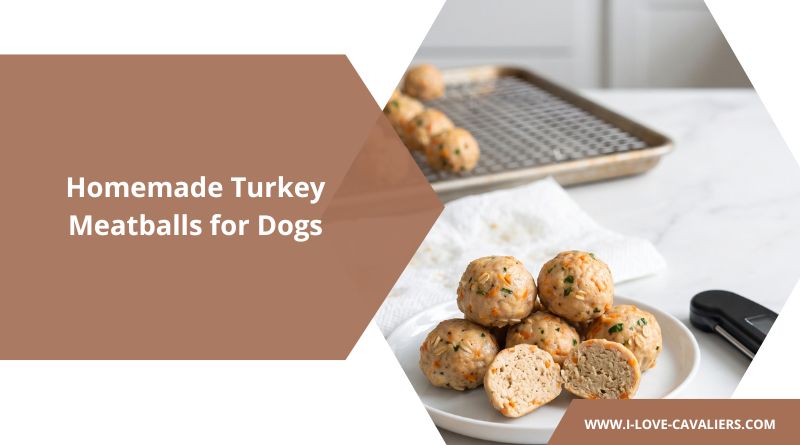
Sunday night, turkey meatballs on the stove. Garlic sizzling in olive oil, half an onion going soft in the pan, and the kind of smell that pulls everybody in the house into the kitchen.
Everybody included my Cavalier. Snickers planted himself at my feet, nose up, tail sweeping the floor like a windshield wiper.
I had one in my hand, ready to toss. Then I looked down at the cutting board covered in garlic skins and onion peel, and put it back on the plate.
He gave me a look I can only describe as betrayed. Fair enough.
So the next morning I made him his own batch. Plain turkey, one egg, a handful of oats, a spoonful of pumpkin and a grated carrot.
No garlic, no onion, no salt.
Gone in about four seconds. Now I bake around 40 at a time, keep a bag in the freezer, and they’ve become his treat, his dinner topper and the only way he’ll take a pill without a fight.
One thing I learned the hard way, though. The package of turkey you grab matters more than anything else in the bowl.
In a Hurry? Turkey Meatballs at a Glance
| Detail | Info |
|---|---|
| Prep time | About 15 minutes |
| Oven | 350°F (175°C) |
| Bake time | 15 to 20 minutes for 1-tablespoon meatballs |
| Done when | The center of the biggest one reads 165°F |
| Yield | Roughly 40 regular meatballs, or about 65 minis |
| Calories | About 24 each (minis about 15) |
| Fridge | 3 to 4 days |
| Freezer | 3 to 4 months |
| Turkey to buy | 93/7, plain and unseasoned |
The one rule I never skip: put a thermometer in the middle of the biggest meatball.
Color lies. The number doesn’t.
Warning: If your dog already grabbed a meatball off a plate, call your vet or the ASPCA Animal Poison Control Center at (888) 426-4435, and keep the recipe in front of you. Since garlic and onion symptoms can take days to appear, don’t wait to see what happens.
Picking the Ground Turkey: 99%, 93/7 or 85/15
Walk down the meat aisle and you’ll usually see three labels. They look alike in the package, but they’re very different meatballs.
| Label | Calories per pound (raw) | Fat per pound | Share of calories from fat | How the meatballs turn out |
|---|---|---|---|---|
| 99% fat-free | About 510 | About 9 g | About 16% | Dry, crumbly, tends to fall apart |
| 93/7 lean | About 680 | About 38 g | About 50% | Holds together, stays moist |
| 85/15 | About 820 | About 57 g | About 63% | Greasy, sits in a puddle of fat |
Numbers from USDA FoodData Central, raw weight. One odd detail: USDA’s lab measured 93/7 at 8.3 grams of fat per 100 grams, a little above the 7% on the label.
93/7 is the one I’d go with. My first batch used 99% fat-free turkey, and half of them broke apart the second I tried to lift them off the pan (and yes, I’ve made this mistake twice).
Look at that third column, though. Even “lean” 93/7 gets about half its calories from fat.
That’s fine for most healthy dogs. Tufts’ veterinary nutritionists point out that many dogs eat high-fat diets and never get pancreatitis, but some health conditions can benefit from diets under 25% of calories from fat.
So if your dog has had pancreatitis, ask your vet before you pick a package. The lower-fat version further down uses the 99% turkey and fixes the crumbling.
One more label check. Grab the plain package, not anything marked seasoned, Italian-style or sausage.
Turkey Meatballs for Dogs Recipe
This is the batch I make most weeks. Six ingredients, one bowl, one pan.
Ingredients
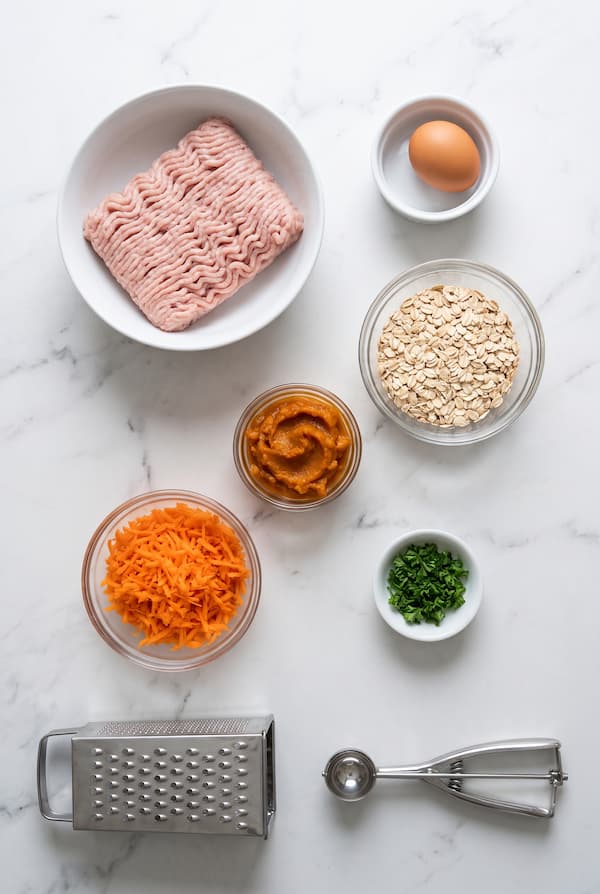
| Ingredient | Amount | Notes |
|---|---|---|
| Ground turkey, 93/7 | 1 pound | Plain and unseasoned |
| Large egg | 1 | |
| Rolled oats | 1/2 cup | Old-fashioned or quick, plain (not flavored packets) |
| Canned pumpkin puree | 1/4 cup | 100% pumpkin, not pie filling |
| Carrot | 1 medium | Peeled and finely grated |
| Fresh curly parsley | 2 tablespoons, chopped | Optional |
No salt, no oil, no seasoning. The turkey brings plenty of flavor for a dog.
Two quick label notes. Pie filling has sugar and spices in it, so the can should say 100% pumpkin.
For parsley, the AKC says curly parsley is the safe one and flat-leaf Italian parsley can be toxic to dogs in large amounts. If curly isn’t what you’ve got, leave it out.
Step 1: Heat the Oven and Line the Pan
Set the oven to 350°F (175°C). Line a rimmed baking sheet with parchment paper.
Even better, set an oven-safe wire rack inside the pan. The fat drips down and away from the meatballs instead of soaking back in.
Step 2: Grate the Carrot and Chop the Parsley
Peel the carrot and run it down the fine side of a box grater. Fine shreds disappear into the meat, while big ones poke out and make the meatballs fall apart.
Chop the parsley small. Nobody wants a leafy meatball, least of all a dog.
Step 3: Mix With Your Hands, Just Until It Holds
Crack the egg into a large bowl and beat it with a fork. Stir in the pumpkin, oats, carrot and parsley.
Add the turkey last and work it in with your hands. Stop as soon as everything looks evenly mixed, because overworked meat turns dense and rubbery once it bakes.
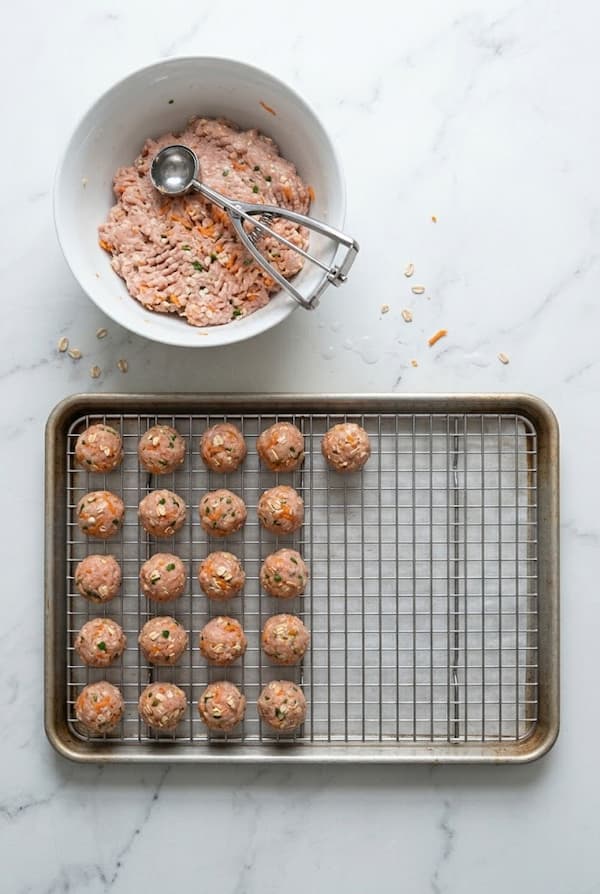
Let the bowl sit for about 5 minutes while the oven finishes heating. The oats soak up some of the moisture and the mix gets easier to roll.
Step 4: Scoop and Roll With Wet Hands
Use a level 1-tablespoon cookie scoop for regular meatballs, about 1 inch across. For small dogs, training or pills, a 2-teaspoon scoop makes minis.
Wet your hands under the tap and roll each scoop gently between your palms. Wet hands, no sticking (sounds silly, but it works).
Set them about half an inch apart. They barely spread, so you can fit the whole batch on one pan.
Step 5: Bake Until the Center Hits 165°F
Bake on the middle rack and start checking at 15 minutes. Most regular meatballs need 15 to 20 minutes, and minis are usually ready around 10.
Push an instant-read thermometer into the center of the biggest one. The USDA puts ground poultry at 165°F, measured with a thermometer, and that’s the number to hit.
Not there yet? Back in for 2 or 3 more minutes, then check again.
Step 6: Drain, Blot and Cool
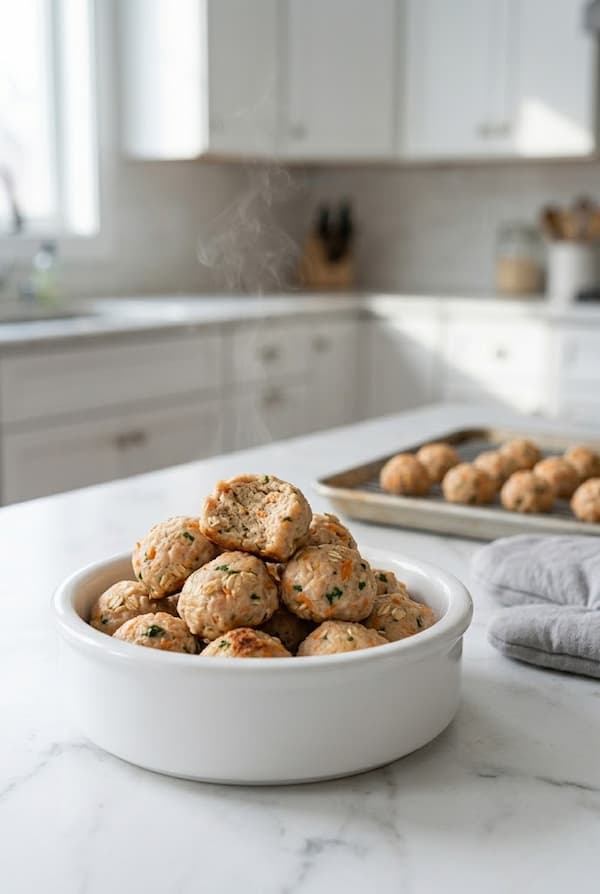
Tip off any fat that pooled in the pan. Roll the meatballs across a paper towel to soak up what’s left on the outside.
Let them cool on the rack until they’re room temperature all the way through. Then into the fridge, within 2 hours of coming out of the oven (1 hour if your kitchen is above 90°F), which is the USDA’s rule for cooked leftovers.
That’s it. The first batch takes about 40 minutes plus cooling time, and after that you can do it without looking at the recipe.
How Many Meatballs a Day, by Dog Weight
None of the top-ranking turkey meatball recipes I checked list calories per meatball. So I did the math with USDA numbers.
| Ingredient | Calories (approx.) |
|---|---|
| Ground turkey 93/7, 1 pound | 681 |
| Rolled oats, 1/2 cup | 155 |
| Large egg | 72 |
| Carrot, 1 medium | 25 |
| Canned pumpkin, 1/4 cup | 21 |
| Parsley, 2 tablespoons | 3 |
| Whole batch | About 960 |
Divide 960 by the number of meatballs you get. A level tablespoon scoop gives roughly 40, so about 24 calories each, and a little less once you pour off the fat.
Minis from the 2-teaspoon scoop come out around 65 per batch, at about 15 calories each.
The World Small Animal Veterinary Association publishes daily calorie ranges for healthy adult dogs, and vets keep treats under 10% of that. Here’s what the low end of each range works out to.
| Dog weight | Daily treat calories (10%) | Regular meatballs | Minis |
|---|---|---|---|
| 11 lbs (5 kg) | 28 | 1 | 1 |
| 22 lbs (10 kg) | 47 | 1 | 3 |
| 33 lbs (15 kg) | 64 | 2 | 4 |
| 44 lbs (20 kg) | 79 | 3 | 5 |
| 66 lbs (30 kg) | 108 | 4 | 7 |
| 88 lbs (40 kg) | 134 | 5 | 8 |
Those are maximums for an average adult dog at a healthy weight, and they cover every treat that day. Pill meatballs count too (trust me on this one, they add up fast).
Using them as a dinner topper instead? Then take the same calories out of your dog’s regular food, so the bowl doesn’t quietly grow.
Just don’t turn them into the whole meal. A UC Davis study of 200 home-cooked dog food recipes found that 95% were missing at least one essential nutrient, and a meatball recipe was never meant to be a complete diet.
If you want to cook full meals, my dog food meal prep guide is the place to start, and talk to your vet before switching over.
Freezing a Batch So It Doesn’t Stick Together
This is where the recipe really pays off. One afternoon of baking, weeks of grab-and-go treats.
Tray-Freeze First
Spread the cooled meatballs on a baking sheet in a single layer, not touching. Freeze them until they’re hard to the touch.
Then tip them into a freezer bag, squeeze out the air and write the date on it. Skip the tray step and you’ll get one giant meatball brick (ask me how I know).
How Long They Keep
| Where | How long | Tip |
|---|---|---|
| Counter | 2 hours max (1 hour above 90°F) | Fridge or freezer after that |
| Fridge | 3 to 4 days | Airtight container |
| Freezer | 3 to 4 months | Bag with the date on it |
Those are the USDA’s times for cooked leftovers. Frozen ones stay safe longer than that, but they dry out and lose flavor.
Thawing and Serving
Move a day’s worth from the freezer to the fridge the night before. Thawing in the fridge keeps them safe the whole time, according to the USDA.
Forgot? Microwave one for a few seconds and break it open to check the middle.
Microwaves heat unevenly, and you’re aiming for room temperature, not hot.
Some owners freeze the raw balls and bake them straight from frozen. That works too, as long as you give them extra time and still check for 165°F.
Two Batches Every Sunday Now
These days, Sunday meatball night means two bowls on the counter. Mine gets the garlic and onion, and his gets pumpkin and a grated carrot.
His tray goes in the oven first. And on weeks when I can’t face rolling 40 little balls, the turkey meatloaf for dogs uses similar ingredients in a loaf pan.
Snickers knows the sound of the cookie scoop now. One click against the side of the bowl and he’s sitting by the oven door, chin up, watching the window like it’s his favorite TV show.
The first one off the rack is always his. That’s the deal, and he’s never once let me forget it.
I’m a passionate dog lover and kitchen enthusiast, but I’m not a certified veterinarian or animal nutritionist. If your dog has had pancreatitis, has diabetes, or takes daily medication, check with your vet before adding a new treat to the routine.
Bon appétit to your furry friend!